

SAL MUBARAK!
Happy New Year to everyone who reads this blog.
I will be revisiting Gujarat in early 2019, and I hope to share my observations and insights about this fascinating part of India with you all.
SAL MUBARAK!
Happy New Year to everyone who reads this blog.
I will be revisiting Gujarat in early 2019, and I hope to share my observations and insights about this fascinating part of India with you all.
Footwear and removing it

In India, I prefer to wear sandals because in so many places it is necessary to remove footwear, and putting on and off sandals is so much easier than doing the same for lace up shoes.
Just in case you are wondering why there is the requirement to bare one’s feet, the reason is to prevent bringing dirt from outside into the place being entered. It is also a mark of respect when entering a religious place such as a mosque, church, temple, or gurdwara.
In some homes, footwear is left by the entrance. This is also the case for some homes that I have visited in the UK. When I went to a junior school in London’s Belsize Park, The Hall School, we left the shoes we had arrived in at the entrance and then replaced them by another pair reserved for use within the school.
When we visited…
View original post 141 more words
Some Hindus are buried rather than cremated…
Death is a morbid but fascinating topic, as is disposal of the dead. Many people living outside India, including myself, believe that the corpses of Hindus are only cremated. At least, I believed this until about 15 years ago, when I visited a Hindu burial ground in Bangalore.
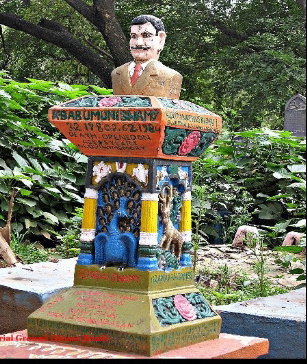 In a Hindu Burial Ground in Bangalore
I have visited two Hindu cemeteries in Bangalore, one of them being next door to a major electric crematorium in the city centre. When I have asked about Hindu burials, I have been told that some sects of Hindus favour burial rather than cremation.
Recently, I read an article about Hindu burials (in Calcutta) by A Acharya and S Sanyal in the “Mint” newspaper (Bangalore), dated 24 Nov 2018. Here is a brief digest of the points contained within it.
1. Certain groups of Hindus are traditionally immersed or buried.
2. These groups include:
A…
View original post 320 more words

In London pigeons are regarded as a nuisance, as pests. A previous Lord Mayor of the city once described them as “flying rats”. Now, feeding them is frowned upon. Gone are the days when you could buy corn to feed the pigeons in Trafalgar Square.
During our long journey through Gujarat in western India, we saw many places dedicated to feeding pigeons. In Bhavnagar, for example, I saw a man scattering seeds, which were being avidly consumed by a large crowd of grey pigeons. The grain was strewn over a large area in which there were several large bowls of water to quench the birds’ thirst.
In Ahmedabad, we saw a fenced off area supplied with drinking bowls as already described. This special feeding area was well supplied with grain scattered on the ground. In that same city, we saw a huge pigeon ‘hostel’. This consisted of a matrix of niches or pigeon holes in which the creatures resided. Feeding facilities were adjacent to the niches. This giant pigeon coop was next to a mosque or dargah close to the Nehru Bridge over the River Sabarmati.
In Rajkot, we spotted a cylindrical concrete pigeon coop mounted on a tall concrete pillar. And, in Porbandar a large area close to the beach is used to feed pigeons and other birds at the end of an afternoon.
During our very recent visit to the metropolis of Hyderabad in Telengana State, we have driven past pigeon feeding areas. On one of the bridges crossing the river, one of these feeding places occupied the whole length of one side of the bridge.
When wandering around the many bookshops in the Koti district of Hyderabad, we found a square surrounded by buildings. The centre of the square is a fenced open space where thousands of pigeons collect to feed on the copious amounts of grain on the floor. This area is overlooked by a cylindrical pigeon coop, which is illustrated above. The area is maintained by The Pigeon Welfare Association of Telengana.
The Lalbagh Gardens in Bangalore have at least one fine large cylindrical pigeon coop. I do not know how many other places in India care for pigeons as I the places I have mentioned, but from what I have seen so far, I can say that India is not devoid of popular concern for avian wellbeing.
Very interesting exhibition
Gujarat Mitra of Sunday 2ndDecember supplement on p.8 carries an article re exhibition of Parsi portraits of eminent Parsi men and ladies. Mr. Anil Relia, a serigrapher artist and collector of portraits is displaying his collection of Parsi portraits at Ahmedabad Gufa at Ahmedabad from 4thto 9thDecember. Parsi sethias of 19thcentury who went to China or Britain had their portraits made. Some of the portraits are by Raja Ravi Varma (1848-1906). A portrait of Rustom-Sohrab of Shah Nameh fame made in 1620 will be on display. Water colour and oil paintings of famous Parsis will be on display. This exhibition brings alive glimpses of times past.(see attachment to view some portraits)

Marzban Giara
Towers of Silence for Parsis living in the USA
Traditional Zoroastrian funerals require stone structures called Dakhmas — “Towers of Silence” — on which corpses are eaten by buzzards, because the Zoroastrian holy text bans other funeral methods.
Excarnatory funeral practices are classified as criminal “Abuse of Corpse” by many state statutes and constitute a misdemeanor to felony offense, thus making traditional Zoroastrian funerals illegal for the 11,000 Zoroastrians in the U.S.
The illegality forces Zoroastrian-Americans to transport their dead overseas which can be prohibitively expensive or to have funerals against their religious mandate.
In a recent scholarly legal article published in the Rutgers Journal of Law and Religion — titled: “Buried, Cremated, Defleshed by Buzzards?” — I analogized the Supreme Court case Church of Lukumi Babalu Aye v. City of Hialeah, noting that Zoroastrianism and the Santeria religion both mandate practices involving dead bodies of people and animals. Employing the decision in that case, I argued that traditional…
View original post 417 more words
There are many elegant moderns buildings in Ahmedabad designed by the architect BV Doshi. He worked with Le Corbusier in Paris. I feel that his buildings bear the sculptural influence of the famous French-Swiss architect, but they are far more user-friendly. We visited Doshi’s studio, Sangath Studio, in Ahmedabad in late March 2018…

The air temperature had exceeded 40 degrees Celsius when we arrived at the Sangath Studio, the offices of the architect’s firm led by BV Doshi. It is open for the public to view on guided tours conducted at 1.30 pm during the company’s lunch break. We were guided around the buildings by a young intern, not a trained architect. She explained to us that Doshi was influenced by what sounded to us like: “Lecobu and Lukhan”. What she meant was ‘Le Corbusier’ and ‘Louis Kahn’, whose buildings in Ahmedabad help make the city a ‘Mecca’ for enthusiasts of 20th century modernist architecture.
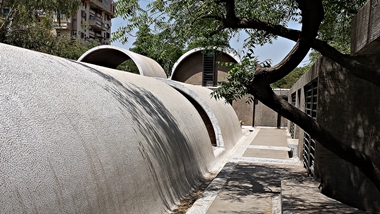
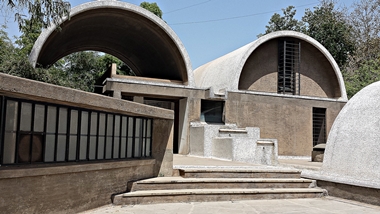
There were many architecture students and architects from other firms on our tour around Doshi’s studio. The students and architects asked no questions but made copious detailed notes. The architectural offices are set in a lovely luxuriant garden with piped music playing. The offices are beneath long white hemi-cylindrical concrete roofs, covered with irregularly-shaped white mosaic pieces like those on the outer surface of the Gufa, a man-made cave which he designed in Ahmedabad. The offices are below ground but lit from windows in the hemi-circular ends of the roofs. Unlike the Gufa, which is only suitable for artistic enjoyment, Doshi’s subterranean offices and studios are beautifully functional. Like Le Corbusier, Doshi designs using modular systems. This is exemplified by a conference room lined with cupboards and drawers whose dimensions vary according to a strict ratio. Doshi also plays with light and shade. Brightly lit rooms are separated by shady ones. The idea being that those who work and design with Doshi should be constantly aware of the importance of light and shade. Sangath Studios provides a visually intriguing and practical environment in which to work.
The Indian Government has just ‘unveiled’ the world’s largest statue, the Statue of Unity. It is 182 metres high and stands in Gujarat between Baroda and Ahmedabad. It is a memorial to Sardar Vallabhai Patel (1875-1950), who was born in Gujarat.

A close associate of Mahatma Gandhi, Patel was a great fighter for India’s independence. When the British finally relinquished their hold over India on the 15th of August 1947, the territory of India was a complex mix of formerly British territory and the so-called Princely States, which were self-governing.
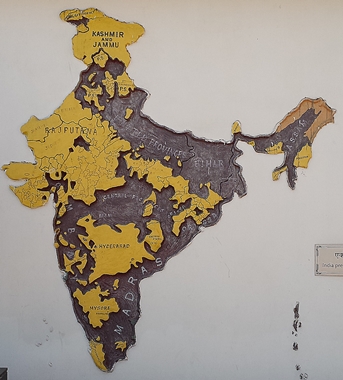
There were well over 500 Princely States embedded within the boundaries of what is now India. Over 200 of these were within the Saurashtra (Kathiawad) district of Gujarat. India in 1947 was a jigsaw puzzle of independent states each with their own ruler. These states were contained within a matrix that was formerly the part of India under direct British rule. After Independence, the rulers of the Princely States were given the choice of becoming part of India or joining the newly formed Pakistan.
Had the Princely States maintained their autonomy after Independence, the Indian subcontinent would have been as complex, if not more so, than the Balkans, and maybe as troublesome. Some of the states like Hyderabad and Junagadh, both large and far from Pakistan, had leanings towards joining with the new Islamic State of Pakistan. Others like Kashmir were not sure with whom to ally.
It was the great skill and statesmanship of Sardar Vallabhai Patel that persuaded the Princely States to join India. Even Junagadh and Hyderabad were eventually incorporated into India. The unification of India was achieved under the leadership of Patel and his colleagues. So, it is fitting that the enormous new statue should be called The Statue of Unity.
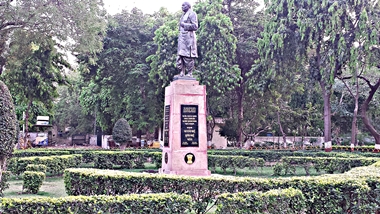
Whether Patel would have approved of the enormous expense involved in creating his latest monument, we will never know!
A famous Swiss-French architect, artist, and writer designed several fine buildings in Gujarat. They are worthy of a visit.

Charles-Édouard Jeanneret (1887 1965), better known as ‘Le Corbusier’ is amongst my favourite 20th century architects. Over the years, I have visited many of his buildings in France, my favourite being his organic, sculptural Chapel of Notre-Dame-du-Haut at Ronchamp. Le Corbusier is well-known in India, which he visited regularly (starting in 1951). In India, he is best-known for designing the city of Chandigarh in northern India.
Ahmedabad, the largest city in Gujarat is home to four notable buildings designed by Le Corbusier. They were built at various dates between 1951 and ’56.

During my recent visit to Ahmedabad, I managed to see two of them. The Sanskar Kendra Museum (1951-56) and Mill Owners’Association Building (1951). Sadly, I was only able to see their fine exteriors, but they confirmed my admiration for their famous architect.

Le Corbusier enjoyed India and her architecture. After visiting the extensive 15th century royal complex at Sarkhej Rauza (on the edge of Ahmedabad), wrote: “You don’t need to travel to the Acropolis. You have everything here.”

Lovers of Le Corbusier’s architecture and of other adventurous 20th century architecture would be well-advised to visit Ahmedabad because many notable modern architects, both Indian and foreign, have designed buildings that now help to adorn the city. I will write about some of these in the future.


The island of DIU is on the south coast of the Saurashtra peninsular in the Indian state of Gujarat.

Diu was a Portuguese colony from the 15th century until 1961, when it was ‘liberated’ by Indian armed forces.


The island is rich in arrchitecture dating back to the golden age of Portugal
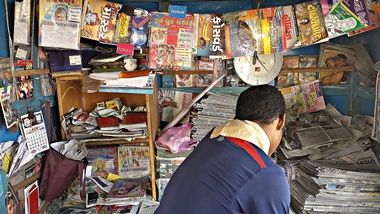
We could only find one newspaper seller in Diu. He opened for a few hours of the day only. Diu is a sleepy place.


The extensive fort of Diu was built by the Portuguese. Part of it is now used as a local jail.
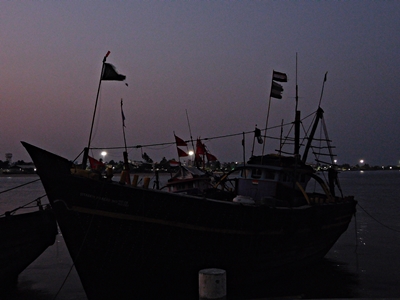

Many fishing vessels moor alongside the city of Diu.


Bird-spotters can enjoy standing by the wateride, looking for various different species.

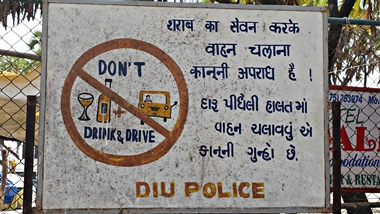
A long road bridge connects Diu Island to Ghoghla on the mainland. Beyong Goghla, there is a frontier post between the Union Territory of Diu and the State of Gujarat. The Gujarati policemen are on the look-out for alcohol being smuggled into thier teetotal state from Diu, where ‘booze’ is permitted.
You can learn more about DIU in “TRAVELS THROUGH GUJARAT, DAMAN, AND DIU” by Adam Yamey.
It is available from lulu.com, bookdepository.com, amazon, and on Kindle


 GUJARAT, DAMAN, and DIU