Sheep ahead

sheep

After leaving Saurashtra, the western peninsula of Gujarat, the landscape became more luxuriant and fertile. We passed fields of grain, cabbages, banana palms, and other crops. There were also plenty of trees.  We drove through Borsad, a place through which Mahatma Gandhi walked on his famous Salt March (Dandi Satyagraha) in 1930. It was also the centre of the district where the great political leader Sardar Vallabhai Patel, who facilitated the merging of the Princely States with India after 1947, led a satyagraha against a punitive tax levied on the district by the British. In recognition of his success, Gandhi dubbed Patel ‘King of Borsad’.

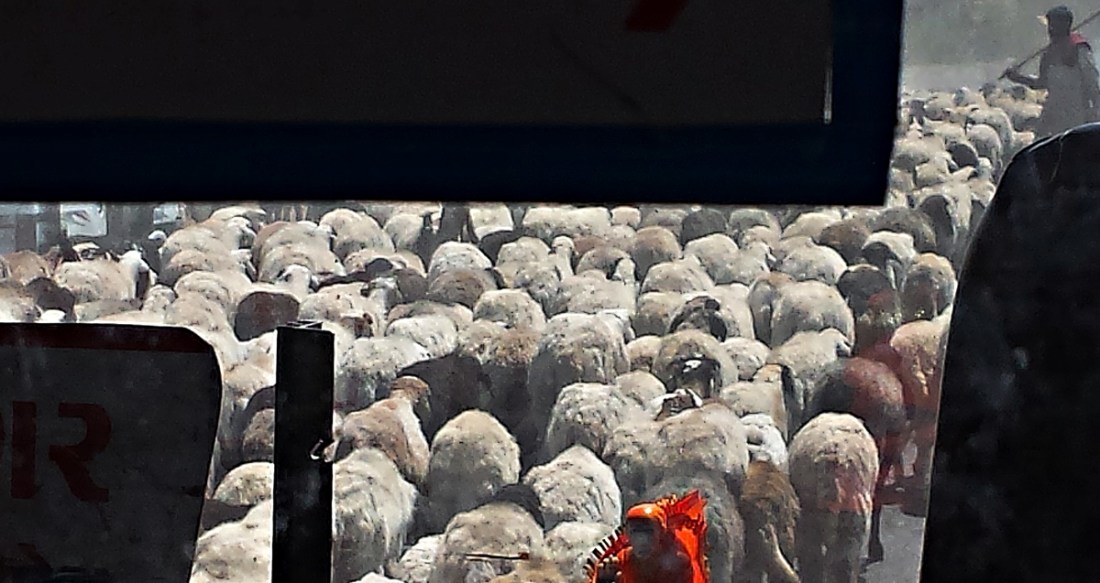
At Borsad, we slowed down to snail’s pace. The traffic was held up by numerous large flocks of sheep and goats being herded along the main road. On one narrow bridge east of Borsad, which crossed a fast-flowing river lined with dense vegetation, overtaking was impossible. Traffic had to travel in single file in both directions. A line of heavy lorries moving in the opposite direction to us was held up by a cow in front of them. She was ambling across the bridge at a very leisurely pace.  

Sun Temple

surya

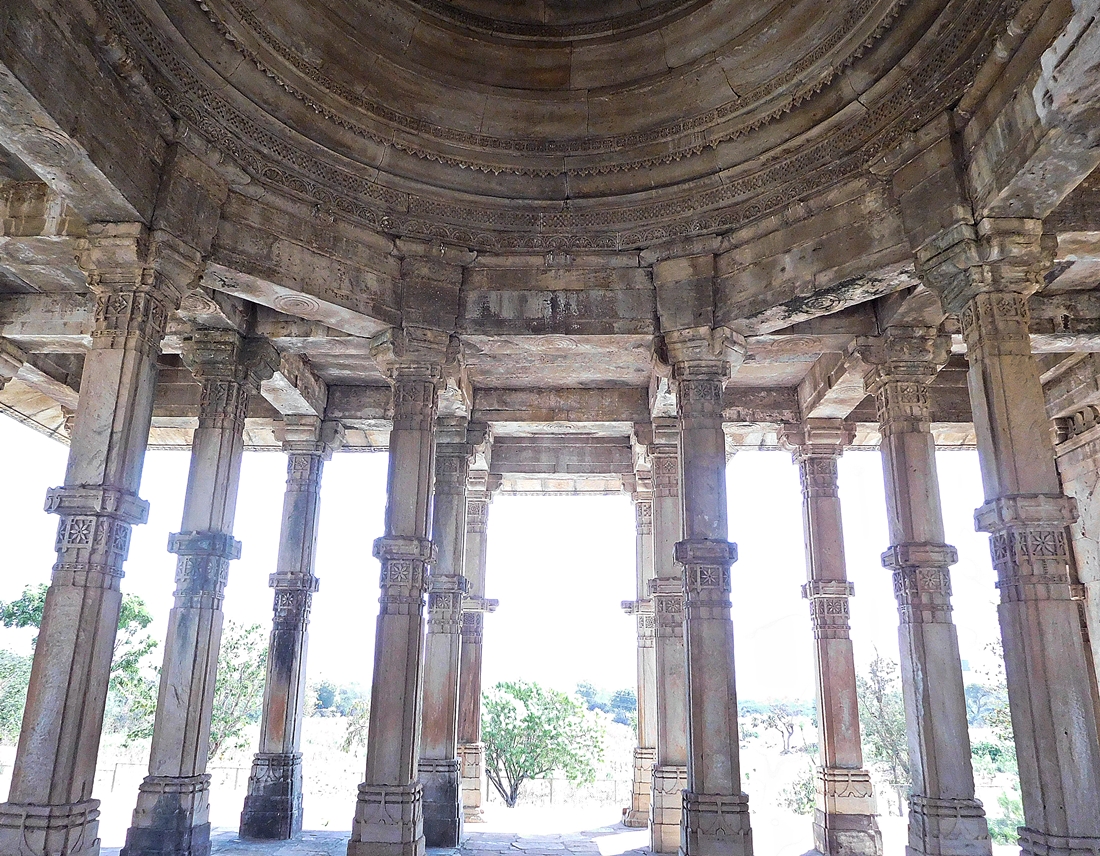
The Surya Mandir near Somnath is on top of a small but steep hill about 300 metres south west of the Gita Mandir. Along with a cow that bounded athletically up the uneven steps, I climbed the staircase up to the temple.  It was well worth the effort.  The Surya (means ‘sun’) Mandir was constructed during the era when one of the mediaeval reincarnations of the Shri Somnath Temple was built. Although the Surya was also attacked by invaders, much of it remains standing even if not in the best condition. It gives a good idea of how splendid the Shri Somnath Temple must have been before the Muslims began damaging it. Well-preserved fine carvings cover the walls of the Surya and extend upwards even covering the lower half its broad-based shikhara. Untrimmed foliage sprouts between some of these sculptures giving the temple an unintended appealing organic appearance. Much of the stonework has a pinkish tinge, which was accentuated by the light from the late afternoon sun. A small boy living in a house facing the temple asked me for a pen. I gave him one. This reminded me of the time when we visited Bijapur in northern Karnataka. Wherever we walked, groups of small boys in the street asked us not for sweets or money, but for pens. This youthful quest for pens is a symptom of a general desire for education in India.

Eggs excepted

eggs

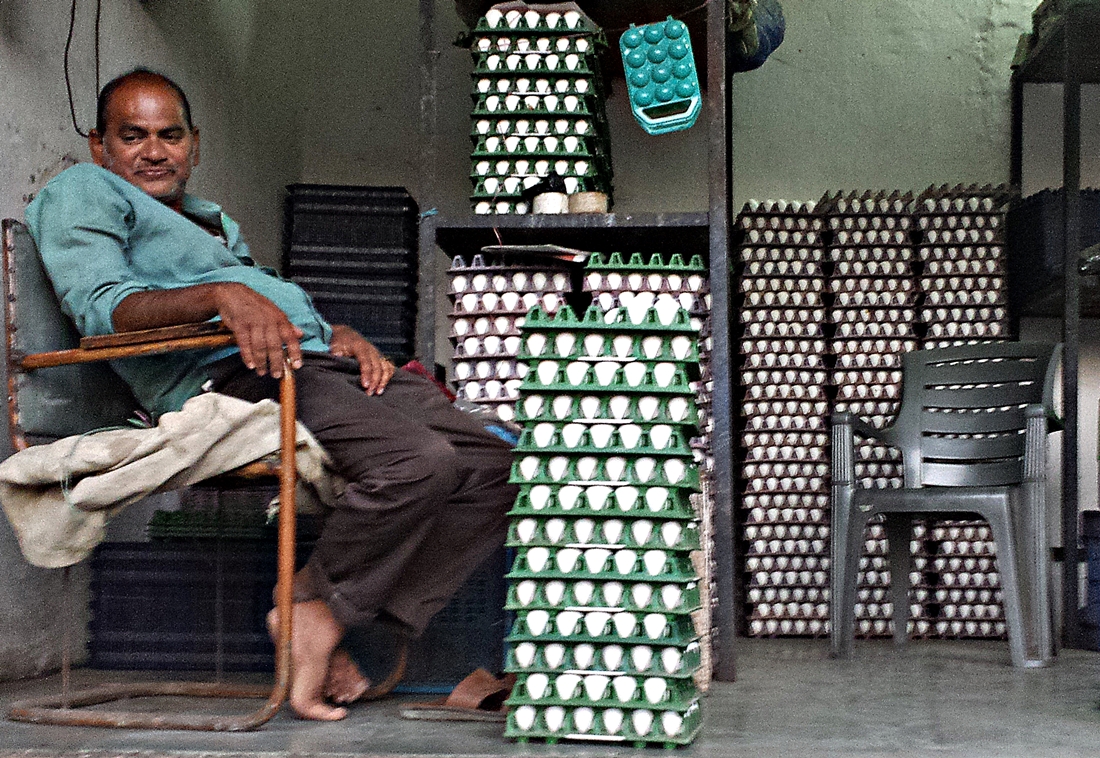
Egg merchant in Vadodara (Baroda)

The Natraj Hotel in Porbandar has a rooftop restaurant, where breakfast can be served. As we were not keen on eating our morning meal on our laps in a bedroom yet again, we sat in the restaurant. It is only open at breakfast time. Once, it had been open for other meals, but no longer. We tried ordering eggs, which were on the breakfast menu. We were told that they could not be served in the restaurant, but only in the bedroom. When we asked why, the waiter informed us that the restaurant is: “pure vegetarian”. Curiously, eggs can be cooked in the restaurant’s kitchen where ‘pure vegetarian’ food is prepared, but they could not be served in its dining room.

Note: Vegetarianism is widespread in Gujarat

Why Gujarat?

PAVAGADH

Pavagadh

Early in 2018, we visited western India. We spent eight fascinating and enjoyable weeks in Gujarat, Daman, and Diu. Before and after our trip, people asked us why we chose to visit Gujarat.

Here is my answer:

Compared with other places in India (for example: Rajasthan, Kerala, Kashmir, The Himalayas, and Goa), Gujarat is relatively unvisited by foreign tourists. We saw no more than about twelve foreigners during our eight weeks in Gujarat and its two former Portuguese enclaves. Most of those whom we saw were in Diu. It is also not a popular destination for Indian holidaymakers.  As I enjoy exploring places less-visited, Gujarat appealed to me.

Another reason for visiting Gujarat is my wife’s heritage. Her father’s family originated in Gujarat, and her mother’s in formerly independent Kutch, now a part of the State of Gujarat. Lopa and I had never visited either of these places.

Yet another reason for our trip was to see the two former colonies of Portugal: Daman and Diu. India is dotted around with territories that remained in foreign hands long after Independence in 1947. We had already been to Pondicherry and Mahé, both formerly French Colonies, and Goa, which was capital of Portugal’s Indian Ocean empire. Each of these places retain a colonial European charm of their own despite having been part of India for several decades. We wanted to discover what is left of the Portuguese influence in Daman and Diu, and we were not disappointed.

I hope that this book will help to introduce the delights of Gujarat, Daman, and Diu to more people. Although we were unable to visit everywhere, I believe that we got a good ‘taste’ of what Gujarat and its lovely people have to offer the visitor.

zoo

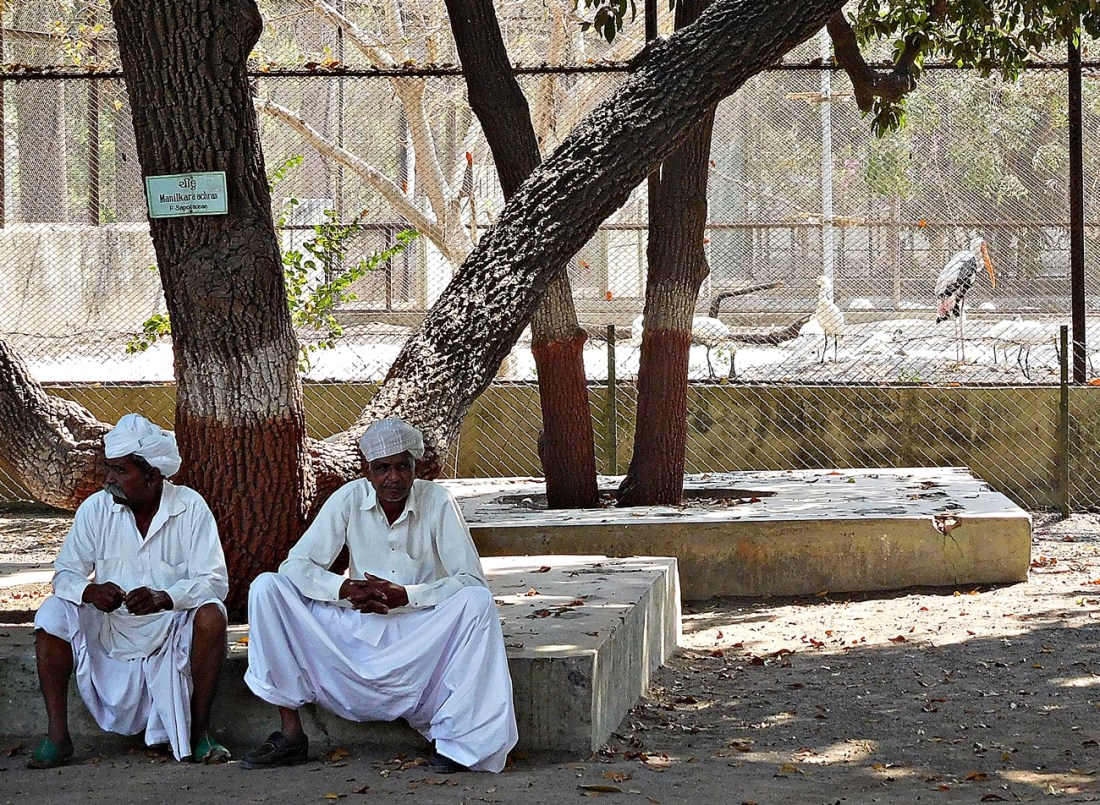
Visitors at Junagadh Zoo

Four bangles

AUDI

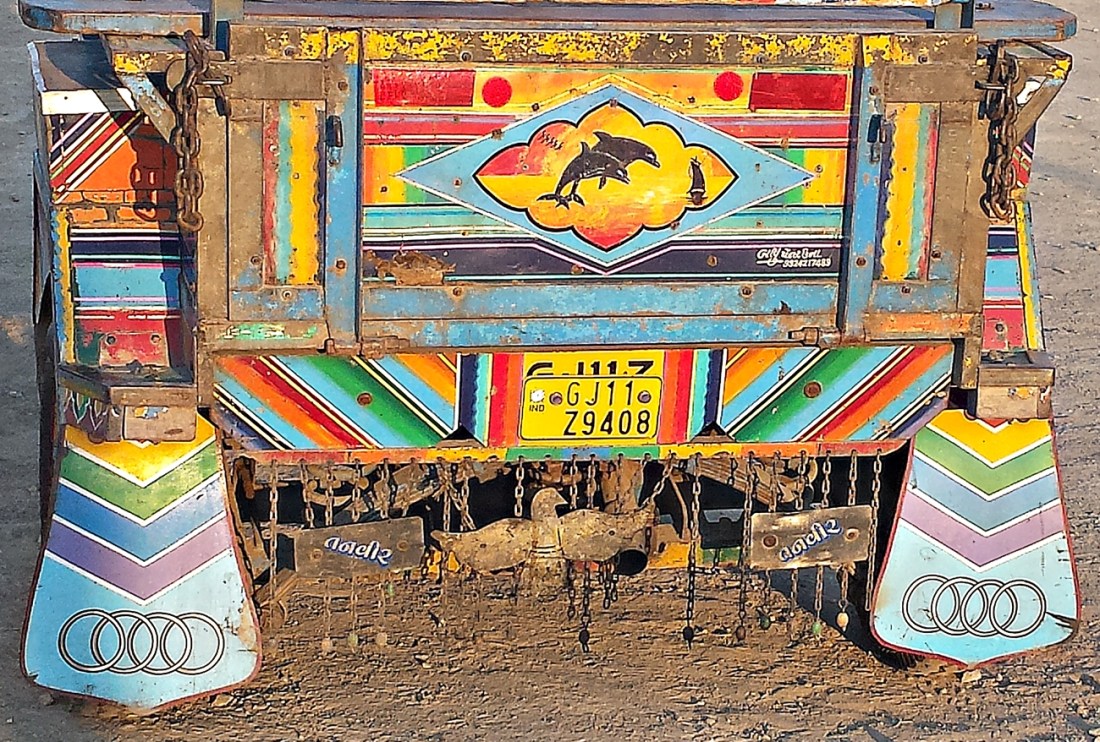
There was a highly decorated chakda* standing close to these boats. Both of its rear mud-flaps had four interlocking rings painted on them, copies of the logo of the Audi automobile manufacturer. This was the first time that we had seen this logo, real or otherwise, since beginning our travels through Gujarat. Some years ago, my late father-in-law used to meet his Gujarati friends for a drink at the Bangalore Club on Saturdays. I used to join them in the Men’s Bar, from which women were excluded until recently. This bunch of friends enjoyed telling jokes. Once, one of them told us that in Gujarat the farmers are so wealthy that they can all buy Audi cars. And because of the logo, they refer to them as char bangdi, which means ‘four bangles’. Having heard this, I was on the lookout for Audis in Gujarat. Until we saw this chakda, I had not seen a single Audi logo. And, it was until almost a fortnight later that I saw an actual Audi car. When I told someone in Gujarat about this, he said that in Saurashtra although farmers can be wealthy they do not tend to waste their money on fancy cars, and elsewhere in Gujarat the wealthy now buy Mercedes rather than Audis.

Note: * chakda: 3 wheeled motorised truck

Encounter in Porbandar

AN AFTERNOON IN PORBANDAR, where Mahatma Gandhi was born.

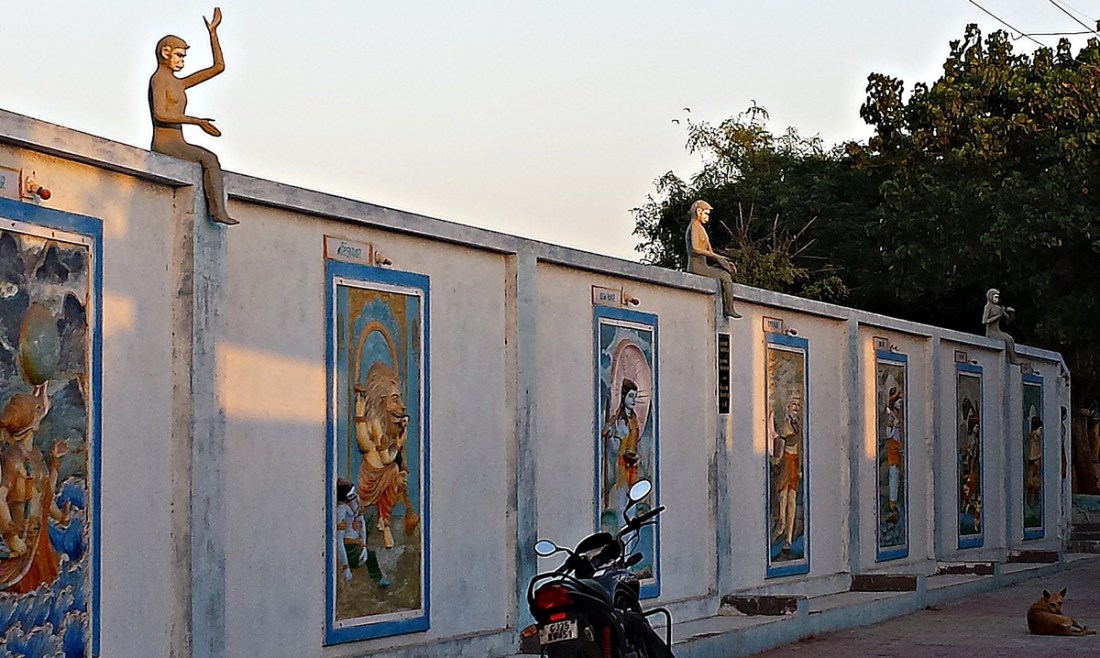
We wandered through the open gateway of a walled compound across the road from the temple. The internal surfaces of the boundary walls were decorated with colourfully painted murals depicting deities and scenes from the Hindu scriptures. Models of very human-looking figures with faces of monkeys perched at intervals along the walls above the murals. The walls enclosed some buildings, long sheds.
PORB

The central, and most important-looking, of these buildings was painted white and provided with glassless windows. Through one of the windows, we could see flames flickering. We realised that we had walked into a crematorium compound. An official came up to us and confirmed our suspicions. Then, as if inviting us to dinner or for a drink in a pub, he asked us whether we would like to watch a cremation. Only in India can an offer like that be made so casually, because as Jon and Rumer Godden wrote in their book Two under the Indian Sun: “We knew, without being told, that in India death was as casual as life, part of every day.”  We declined the invitation.

In the street outside the crematorium, we met a group of young boys, who were keen to chat with us. They told us that they went to local schools, and that they were learning English. However, they preferred speaking in Gujarati. They were knowledgeable about the latest Indian films. As for the controversial film Padmaavati, which we saw in Bombay, they felt the same as we did about it. Even though they told us that they were all of Rajput descent, the boys did not feel that the Rajputs in the film were portrayed insultingly as some critics have said. However, they did feel that the leader of the Muslim army was portrayed unkindly.  

Each of these friendly youngsters had bicycles, which did not look cheap. And, they possessed up-to-date mobile telephones. They would not let us go until we had watched a lengthy video of a local Gujarati popular singer on one of their ‘phones. The video was not so interesting, but it made a pleasant contrast to our unexpected visit to the crematorium. Before we left them, they wanted to be certain that we understood that they all agreed about one thing, and that was people should not: “live for money”, but they should: “think about God”. These thoughtful boys were only fourteen years old.