A pair of minarets is all that remains of a mosque. They stand within the precincts of the main railway station of Ahmedabad. The rest of the mosque was destroyed long ago.
Apart from being attractive, these two minarets, the SHAKING MINARETS, are special. They are able to resist earthquakes. They shake or swing instead of falling to pieces during seismic activity.
The large Jumma Masjid in the heart of Ahmedabad lost its two mighty minarets as a result of movements of the earth long ago.
No one knows why the Shaking Minarets are able to resist seismic disturbances. They are not the only minarets in the city that have this ability. When, long ago, British investigators took one of this kind of minaret to pieces, they were unable to discover the secret of its stability. They were also unable to reassemble the structure properly.
Some suggest that the Shaking Minarets are of Persian design and that their stability has something to do with the sand in their foundations.
I cannot offer an explanation, but would like to make an observation. The Shaking Minarets are constructed with brick like stones that are well separated from each other by something like mortar. Most other minarets that I have seen are made with close-fitting blocks of stone, with minimal gaps between them.
Back in the 1980s, a very violent storm hit the southeast of England, where I was living. As the storm buffeted my house, I could feel it swinging from side to side. I feared it might fall down, but it did not. The house, like the Shaking Minarets, was built of bricks separated from each other by mortar. I felt that the stability of my house was due the fact that the latticework of bricks and mortar gave its walls a flexibility, which absorbed and reduced the impact of the forces hitting it. Maybe, it is the mortar between the brick like stones of the Shaking Minarets that allows them to disperse the seismic energy and by so doing causes them to swing rather than collapse.
I am no engineer. I am just ‘thinking aloud’, but as no one can yet explain the ability of these minarets to resist destruction, I offer the above.
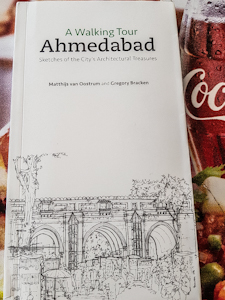
If you are planning to visit Ahmedabad or even if you live there, here is a really useful pocket sized book to get to know the city better.
Published in 2017, A Walking Tour. Ahmedabad is by M van Oostrum and G Bracken. Easy to follow walks take you through the history of Ahmedabad. If you do not wish to follow the walks, this is no problem because the book is well indexed. The book is illustrated with lovely delicate line drawings.
I bought my copy at the excellent bookshop at the Gandhi Ashram on the bank of the Sabarmati, where I was charged 595 Rupees. If you buy it in Europe or the USA, expect to pay far more!
I strongly recommend this book as a very readable and practical guide to the endlessly fascinating city of Ahmedabad.
Street tea making stalls are found all over India. They are great places for quenching your thirst and avoiding low blood sugar situations.
I am writing this during a visit to the Gujarati city of Vadodara, where we spoke to two tea makers this morning. One of them was a charming lady, who told us that she manned her stall from 630 am until 730 pm daily. She heats her tea on a gas ring. The gas cylinder contains enough gas for 15 days.
India’s present Prime Minister, Narendra Modi, worked briefly as a tea maker (‘chai wallah’) during his childhood. There is a chai wallah in Bangalore, whose shop is in Johnson Market. Not only does he serve excellent tea, but also he works as a local politician. He has his own party, whose symbol is a pocket calculator. He stands as a candidate in elections, but has never yet won any of them. He told us that if one chai wallah could become Prime Minister, there is no reason why another could not do the same.
Gopal , who has a tea stall near the entrance to one of the former pols* of Varodara, works from 10 am to 6 pm. His stall was very busy when we visited it this morning. It faces a peepal tree with numerous Hindu offerings around the base of its trunk. One of the daily offerings to the gods is the first cup of tea that Gopal makes each morning.
Like most other chai wallahs we have visited in Gujarat, Gopal adds fresh herbs and spices to his tea. Today, he had large sprigs of mint leaves and bunches of lemon grass and ginger. He pounds the latter in a pestle and mortar. He told us that pounding the ginger releases more flavour than grating it, which is what many chai wallahs do.
I asked Gopal whether I could take photographs of him and his stall. He allowed me to do so. As we were leaving him, he told his customers proudly (in Gujarati):
“Our Prime Minister has to go to the UK and USA to have his picture taken. See, people from the UK have come all the way from London to Vadodara to photograph me.”
* A pol is an ancient form of gated community, built for protection, found in the historic centres of Varodara and (more prevalently) Ahmedabad.
In London pigeons are regarded as a nuisance, as pests. A previous Lord Mayor of the city once described them as “flying rats”. Now, feeding them is frowned upon. Gone are the days when you could buy corn to feed the pigeons in Trafalgar Square.
During our long journey through Gujarat in western India, we saw many places dedicated to feeding pigeons. In Bhavnagar, for example, I saw a man scattering seeds, which were being avidly consumed by a large crowd of grey pigeons. The grain was strewn over a large area in which there were several large bowls of water to quench the birds’ thirst.
In Ahmedabad, we saw a fenced off area supplied with drinking bowls as already described. This special feeding area was well supplied with grain scattered on the ground. In that same city, we saw a huge pigeon ‘hostel’. This consisted of a matrix of niches or pigeon holes in which the creatures resided. Feeding facilities were adjacent to the niches. This giant pigeon coop was next to a mosque or dargah close to the Nehru Bridge over the River Sabarmati.
In Rajkot, we spotted a cylindrical concrete pigeon coop mounted on a tall concrete pillar. And, in Porbandar a large area close to the beach is used to feed pigeons and other birds at the end of an afternoon.
During our very recent visit to the metropolis of Hyderabad in Telengana State, we have driven past pigeon feeding areas. On one of the bridges crossing the river, one of these feeding places occupied the whole length of one side of the bridge.
When wandering around the many bookshops in the Koti district of Hyderabad, we found a square surrounded by buildings. The centre of the square is a fenced open space where thousands of pigeons collect to feed on the copious amounts of grain on the floor. This area is overlooked by a cylindrical pigeon coop, which is illustrated above. The area is maintained by The Pigeon Welfare Association of Telengana.
The Lalbagh Gardens in Bangalore have at least one fine large cylindrical pigeon coop. I do not know how many other places in India care for pigeons as I the places I have mentioned, but from what I have seen so far, I can say that India is not devoid of popular concern for avian wellbeing.
There are many elegant moderns buildings in Ahmedabad designed by the architect BV Doshi. He worked with Le Corbusier in Paris. I feel that his buildings bear the sculptural influence of the famous French-Swiss architect, but they are far more user-friendly. We visited Doshi’s studio, Sangath Studio, in Ahmedabad in late March 2018…
The air temperature had exceeded 40 degrees Celsius when we arrived at the Sangath Studio, the offices of the architect’s firm led by BV Doshi. It is open for the public to view on guided tours conducted at 1.30 pm during the company’s lunch break. We were guided around the buildings by a young intern, not a trained architect. She explained to us that Doshi was influenced by what sounded to us like: “Lecobu and Lukhan”. What she meant was ‘Le Corbusier’ and ‘Louis Kahn’, whose buildings in Ahmedabad help make the city a ‘Mecca’ for enthusiasts of 20th century modernist architecture.
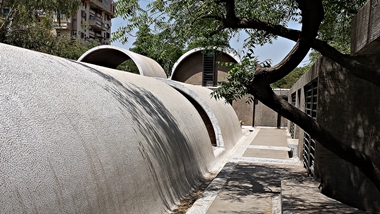
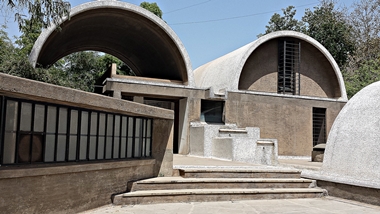
There were many architecture students and architects from other firms on our tour around Doshi’s studio. The students and architects asked no questions but made copious detailed notes. The architectural offices are set in a lovely luxuriant garden with piped music playing. The offices are beneath long white hemi-cylindrical concrete roofs, covered with irregularly-shaped white mosaic pieces like those on the outer surface of the Gufa, a man-made cave which he designed in Ahmedabad. The offices are below ground but lit from windows in the hemi-circular ends of the roofs. Unlike the Gufa, which is only suitable for artistic enjoyment, Doshi’s subterranean offices and studios are beautifully functional. Like Le Corbusier, Doshi designs using modular systems. This is exemplified by a conference room lined with cupboards and drawers whose dimensions vary according to a strict ratio. Doshi also plays with light and shade. Brightly lit rooms are separated by shady ones. The idea being that those who work and design with Doshi should be constantly aware of the importance of light and shade. Sangath Studios provides a visually intriguing and practical environment in which to work.
The Indian Government has just ‘unveiled’ the world’s largest statue, the Statue of Unity. It is 182 metres high and stands in Gujarat between Baroda and Ahmedabad. It is a memorial to Sardar Vallabhai Patel (1875-1950), who was born in Gujarat.
Source: Wikipedia
A close associate of Mahatma Gandhi, Patel was a great fighter for India’s independence. When the British finally relinquished their hold over India on the 15th of August 1947, the territory of India was a complex mix of formerly British territory and the so-called Princely States, which were self-governing.
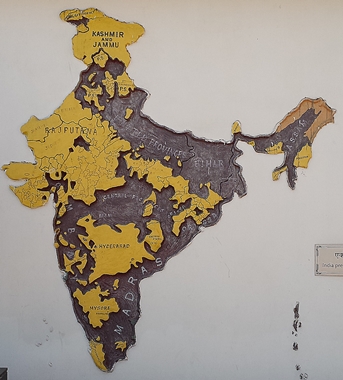
Map at Patel Memorial Museum in Ahmedabad. The yellow parts of the map show the parts of India occupied by Princely States
There were well over 500 Princely States embedded within the boundaries of what is now India. Over 200 of these were within the Saurashtra (Kathiawad) district of Gujarat. India in 1947 was a jigsaw puzzle of independent states each with their own ruler. These states were contained within a matrix that was formerly the part of India under direct British rule. After Independence, the rulers of the Princely States were given the choice of becoming part of India or joining the newly formed Pakistan.
Had the Princely States maintained their autonomy after Independence, the Indian subcontinent would have been as complex, if not more so, than the Balkans, and maybe as troublesome. Some of the states like Hyderabad and Junagadh, both large and far from Pakistan, had leanings towards joining with the new Islamic State of Pakistan. Others like Kashmir were not sure with whom to ally.
It was the great skill and statesmanship of Sardar Vallabhai Patel that persuaded the Princely States to join India. Even Junagadh and Hyderabad were eventually incorporated into India. The unification of India was achieved under the leadership of Patel and his colleagues. So, it is fitting that the enormous new statue should be called The Statue of Unity.
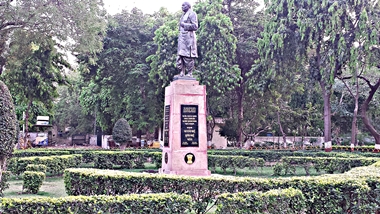
A modest memorial to Sardar Vallabhai Patel in central Ahmedabad
Whether Patel would have approved of the enormous expense involved in creating his latest monument, we will never know!
A famous Swiss-French architect, artist, and writer designed several fine buildings in Gujarat. They are worthy of a visit.
Charles-Édouard Jeanneret (1887 1965), better known as ‘Le Corbusier’ is amongst my favourite 20th century architects. Over the years, I have visited many of his buildings in France, my favourite being his organic, sculptural Chapel of Notre-Dame-du-Haut at Ronchamp. Le Corbusier is well-known in India, which he visited regularly (starting in 1951). In India, he is best-known for designing the city of Chandigarh in northern India.
Ahmedabad, the largest city in Gujarat is home to four notable buildings designed by Le Corbusier. They were built at various dates between 1951 and ’56.
During my recent visit to Ahmedabad, I managed to see two of them. The Sanskar Kendra Museum (1951-56) and Mill Owners’Association Building (1951). Sadly, I was only able to see their fine exteriors, but they confirmed my admiration for their famous architect.
Le Corbusier enjoyed India and her architecture. After visiting the extensive 15th century royal complex at Sarkhej Rauza (on the edge of Ahmedabad), wrote: “You don’t need to travel to the Acropolis. You have everything here.”
Lovers of Le Corbusier’s architecture and of other adventurous 20th century architecture would be well-advised to visit Ahmedabad because many notable modern architects, both Indian and foreign, have designed buildings that now help to adorn the city. I will write about some of these in the future.
Travellers visiting Gujarat should be aware that the majority of food served in the state is vegetarian. In bigger places like Ahmedabad and Baroda, finding non-vegetarian food is less of a problem than in smaller places. If you visit Bhavnagar, the Nilambagh Palace Hotel serves very good food – both veg and non-veg. Many people hanker after Gujarati thalis, but I am not one of these people. Those who are not on the Gujarati meals can easily find well-prepared south Indian vegetarian food like dosas, idli, and vada. Pizzas are also widely available, often with excellent tomato sauce made with fresh tomatos.
Gujarati thali
Another thing to consider when planning your trip to Gujarat is that it is a dry state: alcohol is not served in any public places. It is possible to get a permit (I have no idea how) to be allowed alcohol ‘for medical purposes’ (!) Gujaratis and others desperate for booze can cross the border into either Daman or Diu, both of which were Portuguese colonies until 1961. Now they are administered not by the State of Gujarat, but by the Central Government of India – they are Union Territories. Alcohol is freely available at almost duty-free places in these tiny places, both of which are well-worth visiting.
A mug of chhas
If you are thirsty, there are plenty of soft drinks available including the refreshing watered down yoghurt drink chhas (also known as ‘buttermilk’). Tea is the prevalent hot drink. We found it hard to get decent coffee, let alone any coffee. Most Gujaratis in Kutch and Saurashtra seem to be keen tea drinkers.
Discover more about journeying through Gujarat in Adam Yamey’s new book:
Paperback available from lulu.com, Amazon, bookepository.com, Kindle, or order it from your bookshop [ISBN: 978-0244407988]
I have just returned from a trip to Palermo, the capital of the iskland of Sicily. This island has been invaded by different peoples numerous times. Visiting it made me reflect on aspects of my recent visit to Gujarat
The Zisa Palace built by the Normans near Palermo (Sicily)
In the 9th and 10th centuries (AD), Sicily was ruled by Muslim Arabs. They were displaced by Christian Norman invaders in the 11th century. Little remains of buildings erected during the Arab occupation, but people of Arabic origin remained behind in Sicily when the Normans arrived.
The Normans built castles, churches, and cathedrals in Sicily. Many of these may be viewed today. What interested me about them is that these structures contain many architectural features typical of Arabic architecture. I suspect that the Normans must have employed Arabic craftsmen during the construction of their buildings.
The Norman church of St Cataldo in Palermo
Moving eastwards to India, let us consider the architecture in Gujarat. Gujarat began to be invaded by Muslim forces (Turks, Mughals, etc) in the 14th century. Some Muslim rulers respected the Hindu religion they found when they arrived there; others did not. Hindu temples, like that at Somnath, were vandalised and destroyed.
Recovered remains of an 11th century Hindu temple at Somnath (Gujarat)
Despite a prevailing prejudice against Hinduism, the Muslim invaders were content to borrow the architectural features of Hindu temples when they constructed their new (15th century, mainly) mosques. I have written more about this in an earlier blog article (see:https://gujarat-travels.com/2018/08/04/style-fusion-in-gujarat/).
A 15th century mosque at Pavagadh (Gujarat)
The invaders of both Arabic Sicily and Hindu Gujarat made use of the local architectural features they found when they arrived as conquerors, but they also introduced new architectural styles that they brought with them. The Normans brought northern Gothic, and the Muslim invaders of Gujarat imported Persian architectural ideas. Later, the British, having invaded India, managed to fuse features of gothic, Persian, Mughal, and Hindu architecture to create what is sometimes called “Indo-Saracenic”architecture. Many public buildings in Gujarat are fine examples of this Victorian era fusion.
Inside a 15th century Muslim mausoleum at Sarkej Rauza (Ahmedabad, Gujarat)
Discover more about Gujarat in the new book by ADAM YAMEY:
“Travels through Gujarat, Daman, and Diu“
It is available on lulu.com, Amazon, bookdepository.com, and Kindle
Hop on a bus and travel through Gujarat: see the country and enjoy the people
More excerpts from “Travels through Gujarat, Daman, and DIU“, a travelogue by Adam Yamey, available HERE IN PAPERBACK and HERE ON KINDLE
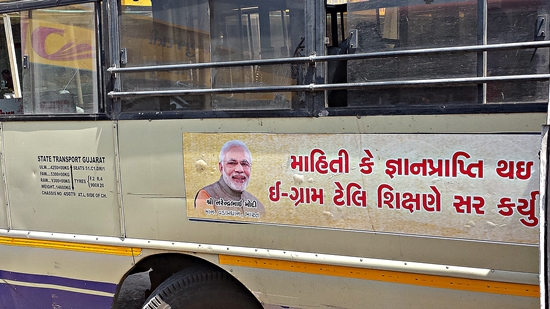
Narendra Modi on the bus
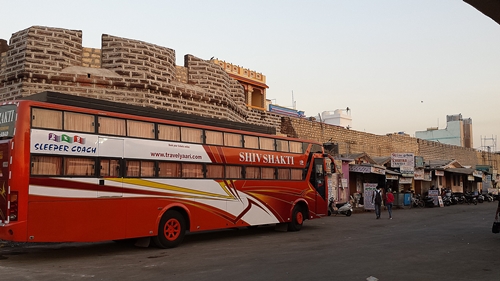
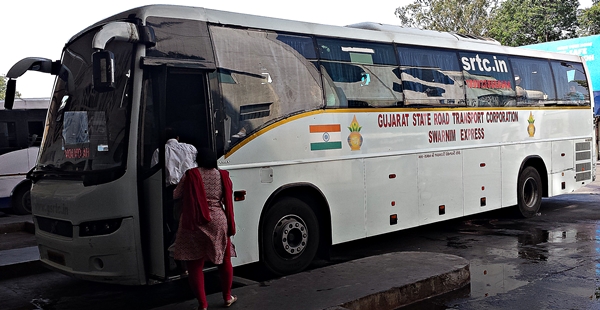
During our eight weeks of travelling through Gujarat, Daman, and Diu, we made much use of public transport. We used mainly buses. As in other parts of India, some buses are run by private companies, and other by the local state, in our case Gujarat, which operates under the name ‘Gujarat State Road Transport Corporation’ (‘GSRTC’). At the outset, we made the assumption that privately-run buses are bound to be better than those run by the state. It was only near the end of our travels that we discovered that we had made an erroneous assumption.
Local bus in Daman
Here are some extracts about buses in Gujarat from my book “Travels through Gujarat, Daman, and Diu”:
On a private bus between Junagadh and Porbandar:
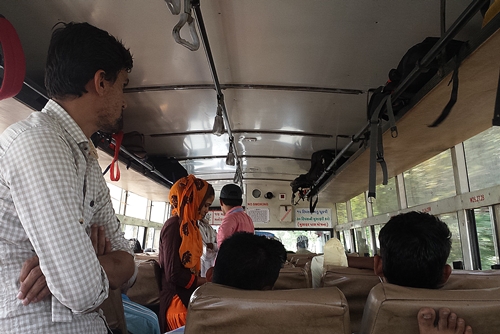
“Our vehicle stopped frequently. Whenever the conductor saw someone standing by the side of the road, he leaned out of the open passenger door, shouting our destination repeatedly: “Porbandar! Porbandar! Porb…” More and more people boarded our small bus. All the seats became occupied as did the space at the front of the vehicle around the driver. As the bus picked up even more people, even the standing room became used up. People were jammed against each other and their arms and baggage invaded the seated passengers’ space. A lady began resting her bag on Lopa’s head. When she objected, the woman said: “Where else can I put it?” Another person almost sat on Lopa’s lap.
There was hardly any room for the conductor. He spent most of the journey leaning out of the passenger door. When Lopa asked him whether this was dangerous, he responded cheerfully that it was part of his job. After about an hour, when the bus was already incredibly crowded we stopped in a village where a large group of people were waiting for our arrival. The bus driver told the conductor that there was no room for any more people. The conductor ignored him and squeezed many new passengers on board.
Our fellow passengers were a varied crowd. They included men with curling handle-bar moustaches wearing turbans and loose-fitting white kurtas with baggy trousers. Their clothes were often stained probably because they were worn whilst doing work on the land. At many rural stops, women wearing colourful garb boarded. Many of them were tattooed on whatever parts of their bodies that could be seen and probably also on parts that were not visible in public…”
Diu bus station
On a GSRTC bus between Diu and Bhavnagar:
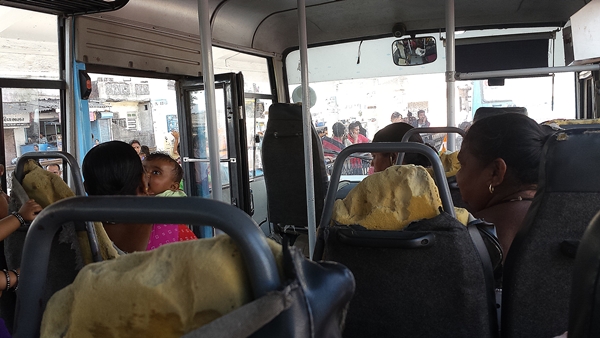
“We boarded a bus belonging to the Gujarat State Road Transport Corporation (‘GSRTC’). This and other buses belonging to the state-run bus company are superior to any of the private busses we had travelled on. The GSRTC vehicles: are cleaner and more comfortable than the private ones; only stop at bus stands with good facilities; do not tout for business at random wayside stops; and do not admit more passengers than there are seats to accommodate them. We wished that we had not assumed, wrongly, that privately-run buses would be better than those run by the state.”
Bhavnagar bus station
On a GSRTC bus to Ahmedabad:
“We boarded the newest and most comfortable bus of our trip at Baroda bus stand. Part of the GSRTC fleet, it was a Volvo vehicle. These buses are held in high regard by Indians. As far as buses in India are concerned, they are regarded as Maharajahs amongst the myriad of road transport vehicles. The coach driver asked Lopa her relationship to me. She replied that I am her husband. The driver shrugged his shoulder and replied in Gujarati: ‘It happens’.”
Whether the bus is privately, or state operated, a ‘back-seat driver’ like me cannot avoid being aware of the adventurous driving of the bus drivers:
“Our driver sped along the good roads leading towards the eastern edge of Saurashtra. He overtook frequently and usually hazardously. Often, he had his head turned towards the conductor sitting left of him, chatting with him, rather than looking ahead along the road in front of him. He also made frequent ‘phone calls to people with whom he was doing business, buying and selling vehicles.”













 GUJARAT, DAMAN, and DIU