This beautifully written short book about Ahmedabad uses sensitively composed vignettes to express the author’s reactions to the inter-communal violence that affected the city in 2002. The author was born and lives in Ahmedabad, about which she has written poetically in her several published books.
Cyrus the Great, King of Persia and a Zoroastrian, ended the Jews’ long captivity in Babylon, and commanded them to rebuild the temple in Jerusalem
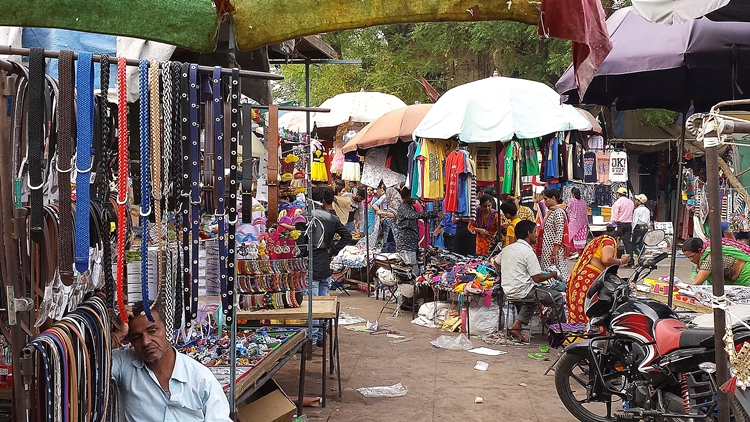
Market near Bhadra Fortress, Ahmedabad
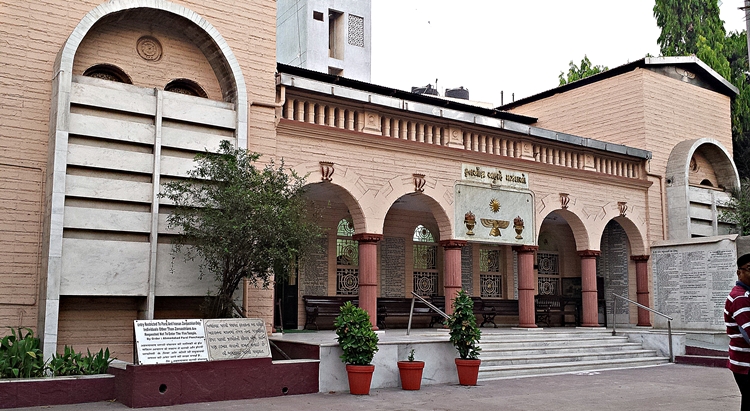
The places of worship of two of India’s minority religions face each other at one end of a small street in central Ahmedabad, not far from the busy market-place by the Bhadra Fortress. One building is the Magen Abraham Synagogue. Opposite, is a Parsi Fire Temple (‘agiari’). Both the Parsis and the Jewish people settled in India long ago and have lived there peacefully ever since. In proportion to their small numbers compared with the rest of India’s huge population, both communities, especially the Parsis, have made a disproportionately large positive contribution to the success of the country. In view of the great benefits they have provided to the country, some say that the Parsis are the ‘Jews of India’. Is this a fair description?
The Portuguese Jesuit priest Father Anthony Monserrate visited India in the early 1580s. After meeting Parsis in Navsari, he commented that they were: “…in colour they are white but are extremely similar to the Jews in the rest of their physical and mental characteristics, in their dress and in their religion.” This illustrates the priest’s poor understanding of the Parsis’ religion but does hint at his feeling that they had some similarities to Jewish people. Other travellers since the 16th century have remarked on similarities in the ways of life and public spiritedness of Jews and Parsis.
Parsi community office, Ahmedabad
The Parsis, followers of the Zoroastrian religion, fled to India from Persia during the 7th century AD to escape the Arab invaders, who wished to impose Islam on their home land. They began settling in Gujarat, where they have thrived for many years without suffering any more oppression than their Hindu neighbours. During various episodes of Islamic rule in India, both the Parsis and the Hindus suffered at the hands of their rulers.
Parsi Fire Temple, Ahmedabad
Nobody is sure when Jewish people first settled in India. Likewise, no one is certain why they did. It might have been, like the Parsis, to escape oppression or, maybe, for commercial reasons. There were Jewish people in Kerala when St Thomas first landed there soon after the death of Jesus Christ. Other Jews arrived on the Malabar and Coromandel coasts later. They were refugees from the persecution of Jews on the Iberian Peninsula following the expulsion of the Moors. Later, others arrived from Iraq. The Jews of Kerala, who have had a largely successful history, and have now mostly emigrated, are different from the Jews, the more indigenous Bene Israel, who settled the states of Maharashtra and Gujarat.
Magen Abraham Synagogue, Ahmedabad
The small congregation of the Magen Abraham Synagogue in Ahmedabad is Bene Israeli. Their origins are quite unknown. In my new book about Gujarat, I wrote: “Ahmedabad’s small Jewish congregation are Bene Israel Jews, whose origin is totally obscure, but the subject of much speculation. One of these is that the ancestors of Bene Israel Jews were originally sailors in King Solomon’s fleet, who got wrecked at Navgaon near Alibag. However, Benjamin Israel, author of ‘The Bene Israel of India’, wrote that there is no evidence for this. Nor is there any good evidence about when the Bene Israel began living in India.”
Magen Abraham Synagogue, Ahmedabad
The numbers of both Parsis and Jews in India are declining. Like many other Indians with economic and other ambitions, both Parsis and Jews have emigrated to ‘improve’ their lives. Parsi numbers in India and beyond its borders are decreasing because of lowered birth-rate. Sayeed Unisa, RB Bhagat, and TK Roy wrote in their paper “Demographic Predicament of Parsis in India” (see: http://iussp2009.princeton.edu/papers/91429) : “Parsis are a small but prosperous religious community of India, which reached a peak of population of about 114 thousand in 1941. The recent census enumerated Parsi population about 69 thousand in 2001.” They concluded that based on available statistics, the population will continue to decline by between 0.6% and 1% per year.
In contrast, the decline in India’s Jewish population is far less to do with birth rates than with emigration. Jewish people have not left India because of persecution. It is safe to say that Jews in India have never been persecuted by Indians or their Islamic invaders. The Portuguese, who began occupying seaports on the coast of India in the 15th century, were almost the only people to persecute the Jews they encountered. Many of them were victims of the Inquisition in Goa. The main reasons for Jewish migration from India are to do with the establishment of the State of Israel and seeking economic betterment.
Many centuries have passed since both the Parsis and the various Jewish communities first settled in India. None of them have encountered as much persecution as the Parsis in 7th century Persia and the Jews in most of Europe. India provided these minorities with a safe haven. In return, both Jews and Parsis have given much to India.
Magen Abraham Synagogue, Ahmedabad
Is it reasonable to consider the Parsis as the ‘Jews of India’?
In terms of religious beliefs and customs, apart from monotheism, there are many differences. Like many of the Jews, the Parsis arrived in India as refugees, fleeing from persecution. Considered from the vantage point of what they have done for the greater good of India, the charitable Parsi communities have contributed to the well-being of India in a magnitude that is infinitely greater than their tiny population is in comparison with that of the country. In this respect, the Parsis resemble the successful Jewish communities of, say, Germany (formerly!), Great Britain, and the USA.
Adam Yamey’s new book about Gujarat, Daman, and Diu
Before and after our 8 week journey through Gujarat, Daman, and Diu, many people asked us why we chose to visit the region.
In Ahmedabad
Here is my answer.
Compared with other places in India (for example: Agra, Rajasthan, Kerala, Kashmir, the Himalayas, and Goa), Gujarat is relatively unvisited by Indian and foreign tourists. We saw no more than about twelve foreigners during our eight weeks in Gujarat and its two former Portuguese enclaves. Most of those whom we saw were in Diu. As I enjoy exploring places less-visited, Gujarat appealed to me.
In Ahmedabad
Another reason for visiting Gujarat is my wife’s heritage. Her father’s family originated in Gujarat, and her mother’s in formerly independent Kutch, now a part of the State of Gujarat. Lopa and I had never visited either of these places.
In Ahmedabad
Yet another reason for our trip was to see the two former colonies of Portugal: Daman and Diu. India is dotted around with territories that remained in foreign hands long after Independence in 1947. We had already been to Pondicherry and Mahé, both formerly French Colonies, and Goa, which was capital of Portugal’s Indian Ocean empire. Each of these places retain a colonial European charm of their own despite having been part of India for several decades. We wanted to discover what is left of the Portuguese influence in Daman and Diu, and we were not disappointed.
In Ahmedabad
Would I recommend others to visit Gujarat, Daman, and Diu?
My answer is an unqualified YES!
The region is rich in historic sights and history, handiwork, folk traditions. There are unspoilt beaches. The people are friendly and welcoming. Places are well-connected by public transport and accomodation is good. What more could you want?
Excerpt from “Travels through Gujarat, Daman, and Diu“, shortly to be published by Adam Yamey
[Ahmedabad]
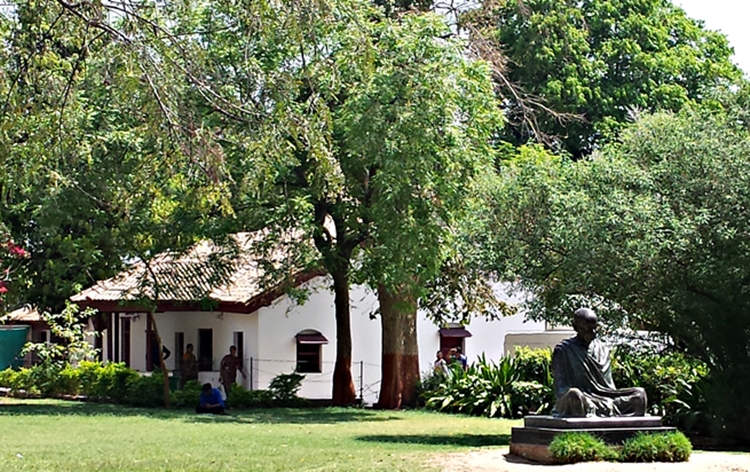
When Gandhi returned to India from South Africa in 1915, having established Tolstoy Farm, an ashram in Natal in 1910, he created one on a small plot at Kochrab, south west of the walled city of Ahmedabad. Gandhi chose Ahmedabad for several reasons: it is a Gujarati speaking city; he had wealthy supporters there; it was an historic centre for handloom weaving; there were mill-owners sympathetic to his cause who would supply him with yarn for spinning; and, most importantly, it was in British territory rather than in a Princely State. It was important, he felt, that the struggle against the British should not be launched from non-British soil. After Ahmedabad, Gandhi established more ashrams in other parts of India. Because of outbreaks of disease at Kochrab and Gandhi’s desire for a larger area for experimenting with farming and khadi production, a new and larger ashram, the Sabarmati Ashram, was set up in 1917 on a site overlooking the Sabarmati, where it remains today. Gandhi lived there until 1930. In March of that year, Gandhi set out from the ashram on his historic 390-kilometre Salt March to Dandi. On the day he set off, he swore that he would not return to the Sabarmati Ashram until India had gained independence from the British. This ashram served as an important centre of India’s Freedom Struggle. Now no longer a working ashram, it is a much-visited and revered place of pilgrimage.
The Sabarmati Ashram is beautifully landscaped. Many of its original single-storey buildings are dotted amongst trees, lawns, and bushes. They are all in immaculate condition, each one housing various exhibits. There is also a superb bookshop, stocking books about Gandhi, his associates, Indian history, and general travel. A small inscribed stone close to some steps leading down to the river marks the Upasana Mandir, an open space that was consecrated for the morning and evening prayers of the inhabitants of the ashram. The stone’s inscription dated 2nd October 1936, Gandhi’s seventieth birthday, records that this was the space where: “…the hallowed voice of many a sermon of Gandhijee still lingers…”
“Travels in Gujarat, Daman, and Diu” by Adam Yamey
To be published very soon!
We were in Ahmedabad when…
… we passed the now disused Indian Picture House, a cinema, and reached the bridge that carries Gandhi Road over Tankshal.
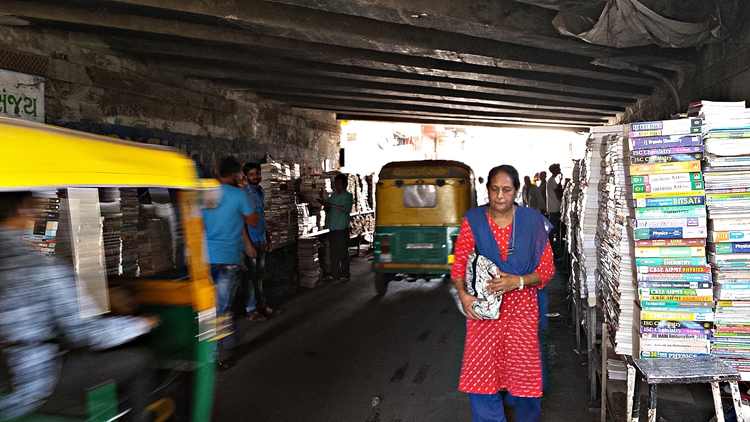
The road beneath the bridge is lined with booksellers’ stalls piled high with textbooks.
There are also bookshops around the bridge in yards leading off Tankshal Road. Outside their premises, there are tables which are overflowing with books, new and used. These precarious piles of books reminded me of my favourite bookshop in Bangalore, Mr Shanbag’s Premier Bookshop, which closed some years ago. In that great establishment, only the foolhardy customer would risk creating an avalanche of books by attempting to extricate a book from the piles of volumes reaching from the floor to the high ceiling.
We visited Mahajan Book Depot, where we had been told books in English were available. Its amiable owner, a descendant of the shop’s founder told us that his was the oldest bookstore in Ahmedabad. His great-grandfather established it in 1891. His stock of books in English was not great, but I found one, a history book, which I purchased.














 GUJARAT, DAMAN, and DIU