Espresso coffee in Diu

diu


Diu is a small island off the south coast of Saurashtra in Gujarat. Formerly, a Portuguese colony (until 1960), it is now part of India.


Shri Ramvijay Refreshment on Bunder Road serves snacks, ice creams and drinks, and is the only place in the city of Diu where espresso coffee can be obtained. The owner bought his Italian espresso-making machine at great expense several years ago. It is a device resembling the Lavazza (LB2312) model for producing single cups of coffee, which was already on the market in 2009. We drank acceptable cups of coffee made with pre-packed coffee capsules placed in this machine. It was the best coffee we had drunk since leaving Bombay, but each tiny cup cost several times as much as the cups of tea available all over Diu and Gujarat. Mr Ramvijay told us that the demand for his coffee was greatest amongst visitors to Diu of Indian origin, who lived in Mozambique and other parts of East Africa.

There are photographs of three previous generations of the Ramvijay family on the café’s rear wall. The present owner Mr Ramvijay explained that his shop was opened in 1933 and has been in business continuously since then. In 1933, it was known as ‘Casa De Refrescos, Ramvijay’. It was started by Shri Mathurbhai Devjibhai Arya, who was born in 1881 in the village of Fudam on Diu Island and established a still functioning soda water factory. Mr Ramvijay told us that he is the major supplier of bottled soda water in Diu. The café is also well-known for its ice cream sodas.


Find out much more about Diu and its neighbour Gujarat, by CLICKING:

HERE or HERE  or HERE

Ginger: pounded or grated?

ginger


The road-side tea-makers found all over Gujarat make hot milky tea flavoured with various additives. Sugar is almost always added. Ginger is another ingredient often used. It is added to the boiling mixture of milk and tea, which is strained through cloth when it has been boiled sufficiently. Many tea makers grate their ginger using metal graters. A few others, like the man in my photograph taken near Manek Chowk in Ahmedabad, prefer to pound their ginger in a pestle and mortar. Whether using grating or pounding  makes much of a difference to the enjoyment of the tea is a matter of personal opinion.

An offering

mendicant


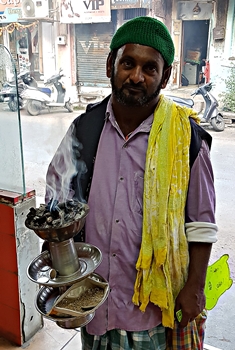
A man carrying hot coals emitting a fragrant smoke entered a small café early one morning in Baroda (Vadodara). He was offering blessings in exchange for a small financial donation. Without displaying any disappointment, he left without having been given any money.

In many religions, fragrant smoke provides a suggestion of holiness.

Two famous vegetarians

gandhi

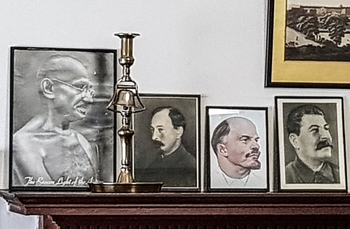
A photograph of Mahatma Gandhi stands above a fire place in the home of the great paywright George Bernard Shaw at Ayot St Lawrence in Hertfordshire. Gandhi, born in Porbandar in Gujarat, met Shaw in London in 1931.

Both of these great men were vegetarians. Shaw said: “Animals are my friends . . . and I don’t eat my friends.” And Gandhi said: “To my mind, the life of a lamb is no less precious than that of a human being.  I should be unwilling to take the life of a lamb for the sake of the human body“. 

While Gandhi never visited Shaw at his home, Jawaharlal Nehru did in 1950.

In the UK, Jeremy Corbyn, the Labour politician, is also a vegetarian. I wonder what Shaw would have thought of him and whether he would have put Corbyn’s photograph on his mantle-piece.


Quotes from https://shawsociety.org/Sri.htm


Bricks for business

BRICKS FOR BUSINESS

Ahmedabad is rich in exciting 20th century architecture, designed both by Indian and non-Indian architects. 

The prestigious, highly-rated IIMA (Indian Institute of Management Ahmedabad) was founded in 1961. Apart from being one of the world’s most respected business schools, its  vast campus is home to an architectural complex designed by the American architect Loouis Kahn (1901-74), who was born in Estonia, when it was part of the Czarist Russian Empire.

His work at the IIMA is a set of brick buildings elegantly designed with archways, circular apertures, and shady walkways.Kahn worked on this project from 1962 until his death. The Ahmedabad-based architect BV Doshi, who studied alongside Le Corbusier and was influenced by Kahn, was also involved in the design, although the greater part of the credit for the design should be given to Kahn. 

We were lucky to have had a contact who was able to get us permission to visit IIMA, which is usually not open to visitors, who have no business with the institute.


Going vegetarian in Gujarat

veg


There are many vegetarians in India, particularly in Gujarat.

I am primarily an omnivore, who enjoys meat and fish.

In many of the places we visited on a seven week visit to Kutch and Saurashtra, it was difficult or even impossible to find restaurants serving non-vegetarian food. I spotted street stalls where omelettes were made to order – and they are very delicious – and barrows where un-refrigerated kebabs were on display in the hot weather, awaiting grilling.

In Kutch, I enjoyed the delicately prepared, tasty vegetarian thalis. In Saurashtra, thalis were less attractive to my taste because of their oily-ness and over use of sugar or other sweeeners. However, Gujarat is a paradise for snackers. All over Gujarat, you will find places selling a variety of delicious farsan (savoury snacks). My favourites include: dhokla, patra, ganthia, sev, bhel puri, chewda, dahi puri, khandvi, and pani puri.

Therefore when I wanted something more substantial, I resorted to eating readily available South Indian specialities such as dosas and curd vada. Or, I ordered pizzas. The pizzas, which would look strange to a Sicilian or a Neapolitan, were delicious despite the fact that the cheese used was not remotely similar to mozzarella. I suspect it was often the industrially prepared Indian Amul product. By the way, Amul was a dairy company established just after Indian Independence in Gujarat, inspired by ideas suggested by Sardar Vallabhai Patel, an important statesman and politician born in Gujarat. Getting back to the pizzas, what made them delicious was the tomato sauces used on them. These were not run-of-the-mill out-of-the-can industrial products. They were usually sauces made in the restaurant using fresh tomatoes and herbs and appropriate spices. Indian Chinese food, even if vegetarian, is also an option.

Well, although I am not a fan of veg food, many people fall in love with the various meat-free and egg-free cuisines of Gujarat.


Fishermen at Mandvi and entering Pakistan

Mandvi


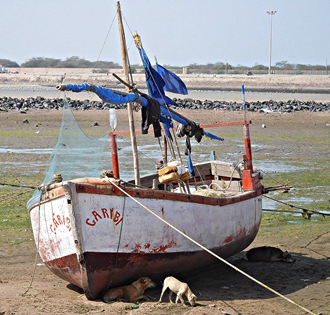
The picture shows dogs resting in the shade provided by a beached fishing vessel in the estuary of the River Rukmavati at the town of Mandvi in the former Kingdom of Kutch, now part of Gujarat.


Nearby, there were many similar fishing boats, all manned by Muslim seamen. These boats sail into the Gulf of Kutch, a piece of water that separates most of Kutch from another part of Gujarat, Saurashtra (or Kathiawad). 


The vessels are allowed to sail as far west as Okha, but no further as they would then stray into Pakistani water. We were told that there is quite a good deal of smuggling between the Indian and Pakistani fishermen. The Indians have to be careful because they might be arrested in Pakistani waters, as a recent newspaper report  reveals:

“A group of 100 Indian fishermen Monday crossed over to the Indian side through 

Attari-Wagah border after the Pakistan government released them from jail as a goodwill gesture.

The fishermen crossed over to India this evening on the basis of ’emergency travel certificates’ issued by the Indian High Commission in Islamabad, officials said.

Immediately after the repatriation, a medical examination of all the fishermen was conducted, they said.

The neighbouring country had released the first batch of 100 Indian fishermen on April 7.

The fishermen were arrested for fishing illegally in Pakistani waters during various operations.

Both the countries frequently arrest fishermen as there is no clear demarcation of the maritime border in the Arabian Sea and these fishermen do not have boats equipped with the technology to know their precise location.”

Quoted from: https://www.business-standard.com/article/pti-stories/pakistan-releases-100-indian-fishermen-119041501180_1.html


Cat without a cage in Junagadh

Tiger


If you happen to visit the city of Junagadh in Saurashtra, and it is really well worth seeing, do not miss taking a stroll around the city’s Sakkarbaug Zoo, one of the oldest zoological gardens in India.

It is justifiably famous for its lions and tigers, which are housed in reasonably spacious cages. The zoo also helps conserve the wild Asian Tigers in the nearby Forest of Gir national park.

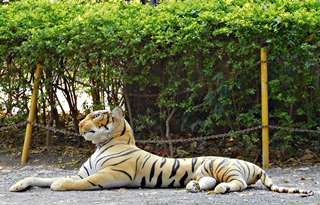
Just after viewing the big cats in their barred enclosures, I turned around and had a shock. I saw what looked like a real tiger lazing on the grass outside the cages. I could not believe my eyes for a few seconds until I realised that this ‘creature’ was actually a realistic life-sized toy tiger, which people used for including in their photographs and ‘selfies’.

Elsewhere in the zoo, there is a model of a dinosaur, but this is not nearly so realistic.

Incidentally, the zoo, which is a little way outside the historic city centre is opposite a great value, comfortable hotel, The Hotel Magnum Inn.

A palace in Kutch

VARSHA blog size


Varsha Bhatia, whose family originated in Kutch, trained as an architect in Bombay. Now, she has become a painter, specialising in water colours. Her delicately executed, finely detailed works display her appreciation of the asethetics of architectural masterpieces.

Following a recent visit to Kutch Mandvi, she has painted a pavilion that is perched on the roof of the Vijay Vilas Palace built by the Maharao of Kutch in a traditional Rajput style during the 1920s . 

My wife and I visited this lovely palace during 2018. This extract from my book Travels through Gujarat, Daman, and Diu describes what we found:

A notice on a wall near the main entrance reads: “Tides come and go but the legend here of sheer enchantment continues unabated”.  On entering the palace, we saw a large banner which exclaimed: “Welcome to palace and experience history which is housed within.” The walls of the pleasant rooms, filled with ageing furniture, are lined with photographs of the royal family, their guests including Indian and British hunters with their servants, alongside the spoils of the regular hunting parties, which used to be held in the palace’s extensive grounds.

Amongst the framed items hanging on the walls, we spotted a 500 Kori banknote issued by the Government of Kutch. It was printed with words both in Gujarati and English scripts. When the Emperor Jehangir (reigned 1605-27) met his vassal, Kutch’s ruler Rao Bharmal (reigned 1585-1631) in Ahmedabad in 1617, Jehangir gave Rao Bharmal the right to strike his own coinage. Thus, the Kori was born. It remained in continuous use in Kutch until 1948, when Kutch became part of the Republic of India.

The windows at the back of the palace look out over formal gardens with dried up water features including a slender stone-lined channel running between bare rectangular patches of ground and fountains. We climbed a spiral staircase to reach the roof of the palace and wandered amongst the domed pavilions with jali screens covering their windows. Another spiral staircase, made of cast-iron, leads to an elevated viewing platform covered with a large domed ceiling supported by pillars. From here, we had a wonderful view of the countryside surrounding the palace and the Arabian Sea.

It is this ‘viewing platform’ that is illustrated in Varsha Bhatia’s lovely water colour work.


TRAVELS THROUGH GUJARAT, DAMAN, AND DIUby Adam Yamey

is available as a paperback from lulu.com, Amazon sites, and bookdepository.com.

There is also a Kindle edition.