History on a stone in Bhavnagar

The Pil Garden in the centre of the city of Bhavnagar (in the Saurashtra district of Gujarat) is a pleasant place to relax. Triangular in plan, the park is named in honour of Sir James Braithwaite Peile (1806-82)[1]. Educated at Oxford University, he entered the (British) Indian Civil Service in 1855. He went to India the following year. He learnt Gujarati and worked in many places in Gujarat including Bhavnagar. Between 1874 and ’78, Peile served as a Political Agent in Saurashtra. He helped to coordinate the activities of the numerous heads of Princely States in the area, including that of Bhavnagar. He also helped organize famine relief during the great famine of 1877. Peile gained the respect of the heads of the Princely States. Mr Peile described the Kingdom of Bhavnagar as follows:

With flourishing finances and much good work in progress. Of financial matters I need say little; you have no debts, and your treasury is full.[2]

Peile left India in 1887, but his name has been immortalised in Bhavnagar by giving it, slightly oddly spelled, to a lovely public garden.

PERC 1

We visited the Pil Garden earlier this year. While I was wandering around, I came across a carved cube of stone partially hidden in some vegetation growing around it. There was an inscription in Gujarati script on one of its faces. On another face, I saw a carved Scottish thistle with some letters carved beneath it: A_RUC_ _ _ L U (or II) S. A third face was carved with a bas-relief depicting the profile of a man wearing a jacket and tie. The face parallel to that bearing the inscription in Gujarati bears the English words: “The Percival Fountain erected by public subscription in 1879 as a mark of esteem for _ _ _ Percival Esq, Bombay Civil Service, Joint Administrator of the State.”

The Mr Percival mentioned on the stone must have been Mr EH[3] Percival of The Bombay Civil Service. His title ‘Joint Administrator of the State’ needs explaining. When Jaswantsingji, the Maharaja of Bhavnagar died in 1870, his son and successor Takhtsingh (1858-96) was only twelve years old, too young to handle the affairs of his state. Until 1878 when he attained his majority, his kingdom was administered by two men[4]: Gaorishankar Udayashankar (1805-1892), a senior and experienced administrator of Bhavnagar, and EH Percival of the Bombay Civil Service. Takhtsingh became a fine ruler of Bhavnagar, executing many useful projects that benefitted his subjects for a long time.

Mr Percival’s administration was considered to have been beneficial to the Indian subjects of Bhavnagar. Even the socialist HM Hyndman (1842-1921), who was a vehement critic of the activities of the British imperialists in India had to admit in his book The Bankruptcy of India (published 1886):

The independent Principality of Bhaunagar was for eight years, 1870-78, under the joint administration of Mr. Percival, a Bombay civilian, and the old State Minister. During this period a complete change took place. The government was reformed in every part, a revenue survey was introduced, and the revenue and trade greatly increased buildings of all sorts, public offices, schools, hospitals, tanks, roads, bridges, lighthouses. So the Bhaunagar State is now by far the most flourishing in Kattywar[5], and the cause of its recent and rapid advance is by common consent allowed to have been the benign influence of Mr. Percival’s presence.”

These were indeed words of praise coming from the pen of a man who believed that the presence of the British in India was hastening the subcontinent’s rapid decline and was doing the Indians no good at all.

One of the many improvements made during Percival’s administration was the city’s water supply. I quote the following, which describes an important urban problem in Bhavnagar and Victorian India in general, from a biography[6] of Percival’s co-administrator Gaorishankar Udayashankar:

For many years the people of Bhavnagar had Suffered for want of a supply of good drinkable water. During the summer season the fresh-water wells in the City failed, with the exception of one or two. Even in the case of this latter, it was painful to see fifty or sixty women gather round the deep well struggling hard to fill their canvas buckets with the limited supply to be found at a considerable depth. Most of the people obtained their supply from temporary wells sunk in the bed of the river Ghadechi, and from a well close by the river, but situated at a distance of two miles from the town, ‘The climatic changes and ‘scarcity of water’, remarked Dr. Burjorji Behrmji, L.M., in a report, ‘influenced the salubrity of the town to a marked degree, and brought on an increase of illness in the shape of malarious fevers, bronchitis, diarrhoea, dysentery, guinea- worm, and dyspepsia in various forms.’

Mr. Gaorishankar had long desired to relieve the 40,000 inhabitants of Bhavnagar by giving them a good water-supply. With the advice and cordial co-operation of Mr. Percival, who thoroughly appreciated this want, he now set about the work in sober earnest. It was found that two miles up the river Ghadechi, there was an excellent site for a large reservoir… The canal carries the water into a reservoir situated in the heart of the town, which supplies, by means of pipes, pure wholesome water to the principal localities. The completion of the works cost the State Rs. 6,00,000. When they were opened to the public, they were, at the desire of Mr. Percival, named after Mr. Gaorishankar.”

What is left of the Percival Fountain might have been part of a gift to celebrate his assistance in the improvement of Bhavnagar’s water supply.

PERC 2

Of the thistle mentioned earlier, I have discovered that some Percival families use the thistle as part of their coat-of-arms. It is likely that EH Percival was Edward Hope Percival (died 1904), who was married to Louisa Jane Wedderburn (1842-1895), daughter of Sir John Wedderburn (1789-1862), who was in the service of the British East India Company.  According to a source in the National Library of Scotland[7], Louisa Jane:

Married at Tibberton, co. Gloucester, 7 Jan. 1869, Edward Hope Percival, of the Indian Civil Service…”

Louisa Jane was the first of her siblings not to be born in India.

Although I have so far been unable to find out the dates of Edward Hope Percival, I have discovered that his collection of various artefacts and peepal tree leaves collected in Bhavnagar were presented to Oxford’s Pitt Rivers Museum by his grand-daughter Alicia C Percival. In their Annual Reports, they refer to Edward Hope Percival as being “Adviser in Bhaunagar State in the Bombay Presidency during the regency of the Maharajah[8]”, thus confirming that EH Hope was Edward Hope Percival.

I am very pleased I discovered the semi-neglected stone in Bhavnagar’s Pil Garden because it has opened up a small window into the colonial past of India.

[1] Biographical details from Dictionary of National Biography (on-line edition)

[2] https://bhavnagar.nic.in/history/

[3] Probably Edward Hope Percival

[4] https://en.wikisource.org/wiki/1911_Encyclop%C3%A6dia_Britannica/Takhtsingji

[5] i.e.: Kathiawad, another name for Saurashtra

[6] Gaorishankar Udayashankar, G.S.I., ex-minister of Bhavnagar, now in retirement as a Sanyasi, by JU Yajnik, publ. Bombay: about 1889.

[7] https://digital.nls.uk/histories-of-scottish-families/archive/95655759?mode=transcription

[8] http://web.prm.ox.ac.uk/sma/index.php/museum-annual-reports/260-1959-60-annual-report.html

Tea in a bag

Tea bag


In Porbandar, the city where Mahatma Gandhi was born, we found a small tea-stall.

As we drank our tiny cups of milky, spiced tea, we watched the chaiwallah filling narrow, cylindrical plastic tubes with hot tea. When these thin-walled short cylinders are almost filled, they are tied closed and handed to customers to drink elsewhere. Later, we learned that these popular thin plastic containers of ‘take-away’ tea pose a potential health hazard because the hot drink leaches toxic chemicals from the plastic. 

The picture above, which was taken in Ahmedabad, shows a portion of take-away tea in a bag rather than a tube. 

Just as in the UK, take-away and home delivery foods and drinks are becoming popular in India. There are many mobile ‘phone ‘apps’ that allow the customer to order the food or drinks in advance. Often, motorcyclists deliver what is ordered. In India, the Swiggy company does the same kind of work as Deliveroo does in the UK. However, hot tea in a plastic bag is a product yet to arrive on the British ‘scene’.

Salt

salt pan

Salt is an essential part of the human diet. In Africa, salt  produced by the Moors was transported across the Sahara Desert to salt-free Central Africa, where it was exchanged for gold. This shows how much salt is valued as a commodity.

On a recent bus trip between the two Gujarati cities of Baroda and Bhavnagar, we passed through a flat low-lying district not far from the sea (the Gulf of Khambat).  Along the way, we passed numerous white piles of salt recently extracted from the sea. These piles stand amongst pools of salty water that is evaporating in the hot sun. Although flat, the landscape is varied and fascinating.

Gujarat is the largest salt producer in India and the third largest in the world. Sadly, the salt workers, whose life is tough and dangerous, are poorly treated by their employers. According to the Indian Express dated April 26, 2016, the Government of the State of Gujarat is looking into ways of improving the lives of salt workers and their families.

So close to Pakistan

kandla


Sadly, India and Pakistan are fighting again. Some parts of Gujarat, such as Kutch, are perilously close to Pakistan.

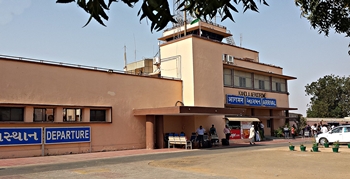
“We boarded a smallish propeller aeroplane, a Bombardier, which serves the daily flight from Bombay in Maharashtra to Kandla in Kutch.

Our one and a half hour Spicejet flight headed north west from Bombay. After traversing Saurashtra, the southern peninsula of western Gujarat (also known as ‘Kathiawad’), we flew over an area of rivers and marshes, and begun descending towards the airport of Kandla in Kutch.

Many centuries ago, Kutch was an island between Gujarat and Sindh. It was separated from the mainland by rivers along its northern and eastern edges, and the sea along its southern edge. The rivers disappeared after a series of seismic disturbances, only to be replaced by arid rocky deserts, the Ranns of Kutch. Until the 1940s, Kutch was fiercely independent of the rest of the Indian subcontinent. Despite frequent attacks by its neighbour Sindh (now part of Pakistan) and the Mughals, the Kutchis retained their autonomy. One of the reasons we were visiting this outlying part of India, now incorporated within the State of Gujarat, was to visit the area from which my wife’s mother’s ancestors originated. Another reason was that we had heard that it is beautiful.

Kandla airport is small. As we descended from the ‘plane onto the tarmac, I noticed that our aircraft was surrounded by army men holding loaded machine guns, their muzzles pointing downwards. There were numerous signs forbidding photography because this airport is primarily a military base only 133 kilometres from the Indian border with Pakistan. There was no baggage conveyor belt system. The luggage from the ‘plane was brought to the tiny terminal in wagons from which we had to help ourselves to our bags.”


This is an excerpt fromTRAVELS THROUGH GUJARAT, DAMAN, AND DIUby Adam Yamey. It is avalable on Kindle and as a paperback from lulu.com, bookdepository.com, and Amazon.

Camels on the beach

CAMELS

Somnath beach


When we visited the beaches at Daman, Kutch Mandvi, and the temple town of Somnath, we saw camels on the beach. Their owners offer rides to holidaymakers, who have come to enjoy the sun, sea, and sand.

However, camels are not only kept for pleasure. All over Gujarat, we spotted camels drawing carts and wagons in towns, villages, and in the open countryside. Apart from being picturesque to my western eyes, they are much valued beasts of burden.

Gujarat and Kutch are areas with a semi-desert terrain and almost desert weather conditions. The camel is ideaaly suited to this environment. Most of the camels used in Gujarat State are bred in Kutch and are highly priced.


Read much more about this fascinating part of  western India in “TRAVELS THROUGH GUJARAT, DAMAN, AND DIU” by Adam Yamey. The paperback is available from lulu.com, bookdepository.com, and Amazon, which also supplies the Kindle version.

Reserved for ladies

RAJKOT

Excerpt from “TRAVELS THROUGH GUJARAT, DAMAN, AND DIU” by Adam YAMEY. Available as a Kindle from Amazon and as a paperback from lulu.com, amazon.com, and bookdepository.com 


The Watson Museum in Rajkot has a good collection of exhibits that encompass the history of the area around Rajkot. Given its age, it is in good condition, and well-worth visiting as is its neighbour in another part of the same building, the Lang Library. It was founded in 1856 by Colonel William Lang, who was a British Political Agent in the Kathiawar region of India, which included Rajkot, from 1846 to ’59. Today, it is named the Arvindbhai Maniyar Library in honour of a former Mayor of Rajkot.

Before entering the spacious reading room, we saw a glass case containing a model depicting the Hindu goddess of knowledge, music, arts, and wisdom, Saraswati, holding a stringed musical instrument in her raised left hand. She was draped with flower garlands. The reading room, surrounded by bookcases and busts of famous people, has many tables and chairs. Almost every chair was occupied by men reading newspapers. Part of the ceiling is made in shiny wood (like a parquet floor) patterned with lozenges containing centrally placed carved wooden rosettes. An elegant staircase with curved wooden bannisters leads to an upper floor. A side room on the ground floor serves a children’s library equipped with miniature desks whose seatbacks are carved to resemble squirrels in profile.

On our way out of the library, we noticed a small table with only enough room for two chairs. It bore a notice in Gujarati saying that it was “reserved for female readers”. One of the chairs was occupied by a young lady, who confirmed that this table is the only place allotted to female readers. When asked what happened when there were more than two female readers, she shrugged her shoulders, and said: “There never are.” The segregation of library users by gender is one of many indications we had that people in Saurashtra retain very conservative views of how life should be lived.

A freedom fighter from Kutch

VARMA HOUSE

Shyamji Krishna Varma (1857-1930) was born in Mandvi in Kutch (now part of Gujarat State). A Sanskrit scholar of world reknown and a barrister, he was also an important, but now not so well-known, activist in the fight for India’s Independence from the British. 

He settled in London in the late 1890s and lived there in the northern suburb of Highgate until he moved to France before 1910. This house, number 60 Muswell Hill Road, was his home between 1900 and 1907. A circular plaque commemorates his short stay here.

An Albanian in Gujarat

While visiting the former Portuguese colony of Diu, an enclave on the south coast of the Saurashtrian peninsula of Gujarat, I came across an open space that provides great views of the fortresses.

DIU MON

It contains a tall, bulky, four-sided column with longitudinal striations. Wire hoops serving as simple steps provide a means of reaching the column’s flat square summit. This is a monument built by the Portuguese to honour of the Gujarati General Khadjar Safar (known by the Portuguese as ‘Coge Cofar’).  The Gujaratis and the Portuguese were enemies and a siege occurred in 1546. This siege of Diu was won by the Portuguese, but Safar was remembered for his bravery. I have seen a picture of this column taken in the 1950s, when it bore a plaque in Portuguese that read in translation: “The tomb of Coge Cofar, instigator of the second siege of Diu. Commander-in-chief of the Turkish and Janissary troops from the kingdom of Cambaya, imposers of the siege of this Fort. In May of the year of 1546, he was killed by a stray bullet that came out from the Fort, penetrated the Turkish forces, and blew off his head. He was brave and courageous.”

Kuzhippalli S Mathew writing in his Portuguese and the Sultanate of Gujarat, 1500-1573 relates that Khwajar (or Khadjar) Safar was born in Italy of Catholic parents, probably Albanians. A successful trader, Safar, with his three boats loaded with valuable spices and drugs, was captured by a general of the Sultan of Cairo, who encountered him in the Straits of Mecca. The captive so impressed the Sultan that together they began planning ways to oust the Portuguese from the Indian Ocean trading arena. Portugal’s activities were wrecking the import of spices to Europe via Egypt. The Sultan gave Safar command of vessels to attack the Portuguese in India. By 1508, he had already fought with the Portuguese near both Chaul and Diu. After many adventures amongst which he fled from Egypt, converted to Islam, and even served the Portuguese briefly, he became an important person in the Sultanate of Gujarat. Both Khadjar Safar and his son Muharram Rumi Khan were killed during the siege of 1546.

This is an excerpt from Travels through Gujarat, Daman, and Diu by Adam Yamey.

Available from Lulu.com, and on Amazon Kindle

Ellis Bridge

Ahmedabad was founded on the east bank of the River Sabarmati in the 15th century. Until 1871, there was no bridge across the river from the city to the west bank. In that year, a wooden bridge was constructed.

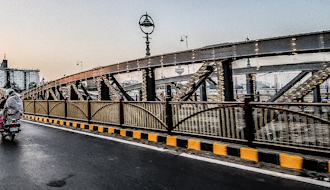
A few years later, the wooden bridge was destroyed by floods. In 1892, a steel bridge was constructed. This was designed by an Indian engineer HD Bhachech and named in honour of a British colonial official named Ellis.

The Ellis Bridge remained in use until 1997, when it was closed. By 1999, two concrete bridges were constructed, one on each side of the old bridge. These new, wider bridges form what is now known as the Swamivivekananda Bridge. The old Ellis Bridge flanked by the two concrete bridges, heavily laden with traffic, has been preserved as a heritage monument.

The old Ellis Bridge, which existed when Gandhi returned to India from South Africa in about 1917, leads from the old city to Kochrab, where the Mahatma set up his first ashram in India.

Spotted in Bhavnagar

Mahatma Gandhi studied for a few months at Samaldas College in Bhavnagar. The Gandhi Smruti in that city contains a first class collection of photographs recording the life of the Mahatma. This echibition is on the first floor of a building. Its ground floor is occupied by the exhibits in the city’s Barton Museum.

The Barton contains some fine artefacts made in different eras. Amongst these, there are some lovely Jain stone carvings.

One area of the museum oncludes a case showing the evolution of the flag of what was to become post-colonial India. Near to this, there is a vitrine containing ageing historic postage stamps in various states of decay.

While looking at the stamps, I spotted several bearing the name “Ifni”. Never heard of it? Well, I had. I used to spot Ifni on the pages of atlases published before the 1960s. However, I had never seen stamps bearing this name.

Ifni was a tiny Spanish colonial enclave on the Atlantic coast of Morocco. The Spanish ruled Ifni from 1860 until 1969, when it was returned to Morocco. The Sultanate of Morocco had ceded the tiny piece of land to Spain in 1960.

According to an article in Wikipedia, Ifni issued several new postage stamps each year. More of them remained unused than used.

I do not know who donated the sheets of postage stamps to the Barton Museum in Bhavnagar, but those from Ifni were certainly isdued orior to 1969.

The museum in Bhavnagar is, like many other museums in provincial towns in Gujarat, filled with a variety of artefacts. You never know what you will find when you enter one of them. The stamps from Ifni were certainly unexpected.