Weaving in Patan

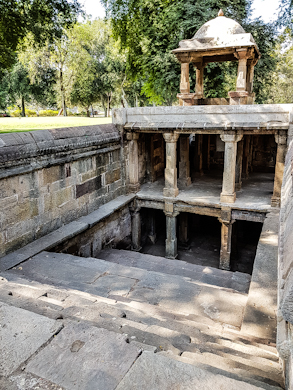
Many people visit Patan in Gujarat to see the spectacular pre 14th century Rani ki Vav, one of the largest stepwells in the state. It was built by the Solanki dynasty.

Patan is also the home of a very special form of weaving called ‘Double Ikat Patola’. The fabrics produced are extremely durable, very colourfast, and display the pattern equally on the front and reverse.

When finished, even the experienced weaver cannot tell which surface of the material is front, and which is back. The textiles are woven to form saris. These are very costly and take many months to manufacture. The method of fabricating this kind of cloth is so complicated that, despite much research, no one has been able to produce a machine to replicate the process that has been done by hand for many centuries in the workshops in Patan.

We were very fortunate to have been shown around one of Patan’s three Patola factories by a member of the Salvi caste, who specialise in Patola making. Although we were given lengthy explanations and demonstrations, I cannot say that I fully understand the complicated process of making a piece of Patola material. However, I will try to explain what I understood of it.

Patola fabrics are woven using the best quality silk thread. That from Japan is preferred, but silk from China, Korea, and Brazil is also considered of sufficiently high quality.

The design for the fabric is chosen and transferred onto graph paper. This coloured diagram will guide the workers towards the desired end product.

Sari length arrays of silk threads are stretched onto frames. These parallel lengths of white or slightly yellow undyed silk are marked with a fine washable black marker to create a grid pattern like graph paper. This will allow the workers to transfer the colour scheme from the coloured diagram to the silk threads.

Next, using the master plan, sections of each thread are wrapped tightly with another thread, which will prevent dye from reaching the covered section. When this laborious task is complete, the whole lattice of parallel threads is dipped into a dye of one colour, say for example red.

After the first dyeing, the lattice is restretched, and all of the dye restricting threads are removed, resulting in a lattice work of threads coloured with stretches of red and white. Let us assume that the next colour on the master pattern is to be green. The stretched silk fibres are then tied with dye restricting threads in all places except where the master pattern dictates there should be green. After dyeing in green dye, the restricters are removed and the process repeated to add yet another colour to the silk. The end result is a set of silk threads with sequences of different colours, a bit like a single strand of DNA or the amino acids in a strand of protein.

A single thread of silk displaying areas dyed in different colours

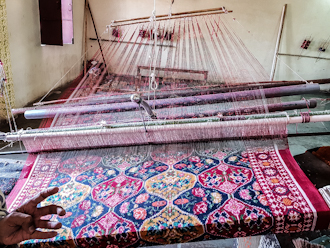
The weaving takes place on looms that hang at an angle. Both the warp and the weft fibres have been tie dyed as described already. When stretched on the loom the as yet unwoven warp threads, when viewed together, display part of the final pattern.

The weft threads pass between the warp threads in a sequence that is dictated by the master pattern. As the weavers press the woven weft fibres together, the sequences of different colours on each thread begin to reveal the required design of the fabric. The prescribed pattern develops gradually, thread by thread.

How the correct sequence of the dyed threads is maintained during the many stages prior to weaving must involve miraculous organization.

Because of the fastness of the dyes used, the Patola fabric does not fade. The method of weaving results in a fully reversible fabric, which is very durable . The other advantages of such a labour intensive and complicated fabrication process elude my comprehension.Nevertheless, Double Ikat Patola saris are greatly prized and highly priced.
A zoo in Ahmedabad

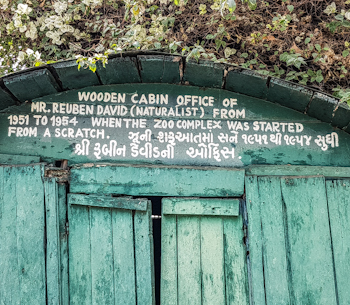
I was very keen to visit the Kamla Nehru Zoo in Ahmedabad. I had read much about it in a fascinating book, The Book of Esther, by the Ahmedabad author Esther David. She was born into a Beni Israel Jewish family. Her father Reuben David, a self taught veterinarian and keen naturalist, established the zoo on the shore of Lake Kankaria in 1951. The lake is man made and dates from the mid 15th century.

You can explore the zoo on foot or, for a modest fee, you can be driven around it in an electric vehicle. The driver stops wherever you wish and also helpfully draws your attention to cages and enclosures containing interesting creatures. Some of the cages look quite old and a little cramped, but the enclosures are quite spacious.

The reptile house contains a series of generously large enclosures housing snakes, both venomous and not.

Recently, a new part of the zoo has been built a little way around the lake, separated from the original establishment. The new part is called ‘Nocturnal Zoo’. Barely lit corridors connect poorly illuminated cages. Once your eyes have adapted to the darkness, you can view animals who are usually most active at night. Some of these animals seemed to enjoy sleeping in the artificial night. Others, including various bats and beautiful owls and some jackals, were fully awake. The Nocturnal Zoo is well designed and, I hope, would have met with the approval of the very creative Reuben David.

Shaking minarets

A pair of minarets is all that remains of a mosque. They stand within the precincts of the main railway station of Ahmedabad. The rest of the mosque was destroyed long ago.

Apart from being attractive, these two minarets, the SHAKING MINARETS, are special. They are able to resist earthquakes. They shake or swing instead of falling to pieces during seismic activity.

The large Jumma Masjid in the heart of Ahmedabad lost its two mighty minarets as a result of movements of the earth long ago.

No one knows why the Shaking Minarets are able to resist seismic disturbances. They are not the only minarets in the city that have this ability. When, long ago, British investigators took one of this kind of minaret to pieces, they were unable to discover the secret of its stability. They were also unable to reassemble the structure properly.

Some suggest that the Shaking Minarets are of Persian design and that their stability has something to do with the sand in their foundations.

I cannot offer an explanation, but would like to make an observation. The Shaking Minarets are constructed with brick like stones that are well separated from each other by something like mortar. Most other minarets that I have seen are made with close-fitting blocks of stone, with minimal gaps between them.

Back in the 1980s, a very violent storm hit the southeast of England, where I was living. As the storm buffeted my house, I could feel it swinging from side to side. I feared it might fall down, but it did not. The house, like the Shaking Minarets, was built of bricks separated from each other by mortar. I felt that the stability of my house was due the fact that the latticework of bricks and mortar gave its walls a flexibility, which absorbed and reduced the impact of the forces hitting it. Maybe, it is the mortar between the brick like stones of the Shaking Minarets that allows them to disperse the seismic energy and by so doing causes them to swing rather than collapse.

I am no engineer. I am just ‘thinking aloud’, but as no one can yet explain the ability of these minarets to resist destruction, I offer the above.

A useful book

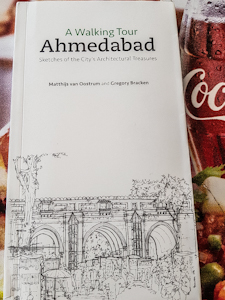
If you are planning to visit Ahmedabad or even if you live there, here is a really useful pocket sized book to get to know the city better.

Published in 2017, A Walking Tour. Ahmedabad is by M van Oostrum and G Bracken. Easy to follow walks take you through the history of Ahmedabad. If you do not wish to follow the walks, this is no problem because the book is well indexed. The book is illustrated with lovely delicate line drawings.

I bought my copy at the excellent bookshop at the Gandhi Ashram on the bank of the Sabarmati, where I was charged 595 Rupees. If you buy it in Europe or the USA, expect to pay far more!

I strongly recommend this book as a very readable and practical guide to the endlessly fascinating city of Ahmedabad.

ISBN 9789385360176

Published by Mapin in Ahmedabad

Winter in Bhavnagar

Bhavnagar is a very pleasant, but less visited, city in Gujarat’s Saurashtra peninsula. Close to the sea, it was established by the Gohil dynasty in the 18th century

We arrived in Bhavnagar in late January 2019 after spending a week in Baroda. The weather in Baroda was warm (29 to 31) degrees Celsius and we need to use air conditioning even in the evenings.

Here in Bhavnagar there are cooling breezes. The daytime temperature is extremely pleasant. At midday, the temperature hit a high of 24. At night, the air becomes distinctly chilly even for someone used to British weather. Air conditioning is not required at all at the moment. Locals dress up warmly with heavy outer clothing and warm head gear.

Straying away from meteorology, Bhavnagar has a very friendly climate. People are friendly, humorous, and helpful.

To exemplify the above, let me tell you about one incident. My wife and I were ordering tea at a roadside chaiwalla stand. A man sitting close by waved a banknote at us and insisted on paying for our tea. As he did so, he said in Gujarati:

“You are our guests in Bhavnagar “.

This kind of behaviour is typical of the welcoming folks in Bhavnagar.

Tiny clothes

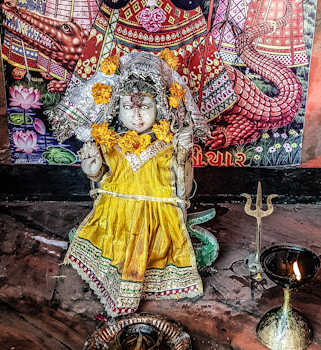
In markets throughout Gujarat, I have seen shops selling elaborately made miniature clothes, which are often too small to fit the tiniest of human children. At first, I thought that these were toy clothes to dress dolls. But, I was mistaken.

A man selling these tiny garments explained to me that they are for dressing the idols of deities in Hindu shrines. The picture above, taken in central Vadodara, shows such a deity clothed with one of these miniature outfits.

Buzzing around Baroda

The best way to get around Baroda (now ‘Vadodara’) is by three wheeler autorickshaw (‘auto’). There are plenty of these nifty little vehicles for hire and although their drivers hardly ever use the meters, the fares are remarkably reasonable.

Unlike Bangalore, where the auto drivers are often argumentative and dodgy about fares, the drivers in Baroda are usually straightforward and friendly.

We have made a couple of long journeys in Baroda. As the auto drivers were uncertain about what to charge, they used their antiquated meters. These must have last been calibrated many years ago. According to such a meter, a journey of about 6 kilometres should cost 4 rupees and 20 paise. This is ridiculous because the shortest auto journey in Baroda costs 20 rupees today. The auto driver looks at his ancient meter and then, without looking at a conversion table, decides on a fee. We made the 4 rupee and 20 paise journey twice. Once, we were charged 100 rupees, and the other time 120. Both amounts are reasonable, and far less than you would pay in a Bangalore auto or a Bombay taxi.

I favour autos over cars for getting around cities in India. The former are far more manoeuvrable than the latter. This is vital in a city like Bangalore, where traffic is poorly managed. In Baroda, however, traffic flows brilliantly compared with Bombay or Bangalore.

Unless you have huge amounts of baggage, hop into auto in Baroda.

A globe trotting chef in Gujarat

So-called Italian food is popular in India. Indians are fond of pasta and pizza and are happy to eat almost anything that claims to fall into these categories. Often what is served as “Italian food” would be almost unrecognizable to Italians.

However, things are changing. Increasing numbers of Indians now visit Europe and many Europeans and Americans familiar with authentic Italian food visit India. They are more discerning than about the quality of Italian food served in India than Indians who have not been abroad.

Despite this, very few Italian restaurants in India are serving what I would consider Italian food like Mamma would make. Chianti Restaurant in Koramangala (south Bangalore) does makes the grade.

Tonight, I ate at Fiorella in the Alkapuri district of Vadodara in Gujarat. This Italian restaurant serves brilliant food. It is Italian food which makes no compromises to satisfy traditional Indians’ palates.

We met Ravichandra, Fiorella’s chef. He speaks Italian fluently, which is not surprising as he lived and worked in various cities in Italy for 14 years. He has lived abroad, mostly in Europe, for a total of 22 years.

He became a member of the Federation of Italian Chefs. He worked as a consultant advising the owners of Italian restaurants all over the UK. Spending 3 months in each restaurant, he helped their owners improve their establishments.

Following his return to India in 2008, Ravichandra, who was born in Kerala, worked in various hotels and restaurants before 2012, when the owner of the Express Residency Hotel in Vadodara asked him to set up Fiorella. The plan was to establish Fiorella as a totally authentic Italian eatery, whose food was not at all adapted to Indian tastes. This, Ravichandra has achieved most successfully. An Italian eating here would not be disappointed.

Two zoos

To date, I have visited two zoos in Gujarat: Junagadh and Vadodara. I have yet to visit a third, that in Ahmedabad.

The zoo in Junagadh is laid out over a large area of ground. Large animals and those which like to run around are in spacious enclosures. The zoo is pleasant to visit. It has wide paths, many of them with trees to provide shade.

Currently (January 2019), the zoo in the Sayajibaug Gardens in Vadodara is somewhat of a building site. This zoo is undergoing major rebuilding. The zoo is divided into three areas: birds, hippos and big cats, tigers and bears. There are also ponds containing crocodiles and alligators. The highlight of our visit to this zoo was seeing a new born hippopotamus with its mother.

The cages at the zoo in Vadodara are mainly very old fashioned. Hence, the building works whose aim is to create modern enclosures and a veterinary hospital.

I know that these days not everyone approve of keeping animals in zoos, but both zoos described above are well worth visiting.

Large snakes

The Laxmi Vilas Palace in Vadodara was built for the Gaekwad (Maharajah) of Vadodara in 1890 to the designs of the British architects Charles Mant and Robert Chisholm. It covers an area four times as large as London’s Buckingham Palace. This Victorian era Indo-Saracenic pile is now one of the main tourist attractions of Vadodara. What little of it that visitors are permitted to explore of this pastiche of various Asian and European architectural styles is overbearingly impressive but not of great aesthetic value.

My main reason for visiting the palace was to see the Navlakhi Vav, a subterranean stepwell built in the 15th century. The stepwell has five levels of stonework galleries, all underground and one above the next. I was looking forward to exploring this, rather than the relatively uninteresting palace.

The official at the ticket booth for the palace compound told us that the ticket included access to the vav. He omitted to tell us that approaching this stepwell is now forbidden.

A security guard stands about 50 metres from the domes built above the vav. He told us that he would lose his job if he allowed us to go closer to the stepwells. Although his job was poorly paid, so he told us, it would be difficult for him to find another. He suggested that we returned to an office in the palace and spoke to a young lady whom we would find there.

When we explained my interest in stepwells to her, she accompanied us back to the guard, telling us that we could approach the outer walls of the stepwell but should not enter it. At present, she explained, the vav was not in good condition because stones kept falling from its structure. Additionally, the stepwell is currently infested by large snakes. She told the guard to take us to the structure. Although we could not enter the complex structure of the vav, we were able to see something of it over the low walls enclosing it at ground level. We could hear water splashing deep below us in the well in the deepest part of the stepwell.

The serpent infested vav is separated from where the guard stands by the tee of one of the 18 holes of the Laxmi Vilas golf course. We asked the guard whether the golfers, who had to stand close to the vav, were in any danger from the large snakes.

“No,” he replied in Gujarati, “they are not.”

“Why not?” we asked.

“Because they are members of the golf club,” the guard informed us.