

The Laxmi Vilas Palace in Vadodara was built for the Gaekwad (Maharajah) of Vadodara in 1890 to the designs of the British architects Charles Mant and Robert Chisholm. It covers an area four times as large as London’s Buckingham Palace. This Victorian era Indo-Saracenic pile is now one of the main tourist attractions of Vadodara. What little of it that visitors are permitted to explore of this pastiche of various Asian and European architectural styles is overbearingly impressive but not of great aesthetic value.
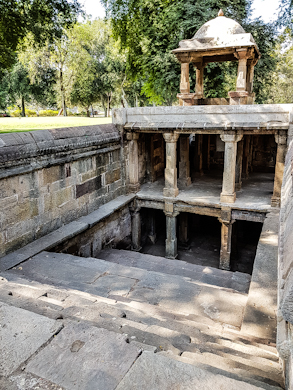
My main reason for visiting the palace was to see the Navlakhi Vav, a subterranean stepwell built in the 15th century. The stepwell has five levels of stonework galleries, all underground and one above the next. I was looking forward to exploring this, rather than the relatively uninteresting palace.
The official at the ticket booth for the palace compound told us that the ticket included access to the vav. He omitted to tell us that approaching this stepwell is now forbidden.
A security guard stands about 50 metres from the domes built above the vav. He told us that he would lose his job if he allowed us to go closer to the stepwells. Although his job was poorly paid, so he told us, it would be difficult for him to find another. He suggested that we returned to an office in the palace and spoke to a young lady whom we would find there.
When we explained my interest in stepwells to her, she accompanied us back to the guard, telling us that we could approach the outer walls of the stepwell but should not enter it. At present, she explained, the vav was not in good condition because stones kept falling from its structure. Additionally, the stepwell is currently infested by large snakes. She told the guard to take us to the structure. Although we could not enter the complex structure of the vav, we were able to see something of it over the low walls enclosing it at ground level. We could hear water splashing deep below us in the well in the deepest part of the stepwell.
The serpent infested vav is separated from where the guard stands by the tee of one of the 18 holes of the Laxmi Vilas golf course. We asked the guard whether the golfers, who had to stand close to the vav, were in any danger from the large snakes.
“No,” he replied in Gujarati, “they are not.”
“Why not?” we asked.
“Because they are members of the golf club,” the guard informed us.

 GUJARAT, DAMAN, and DIU