Buzzing around Baroda

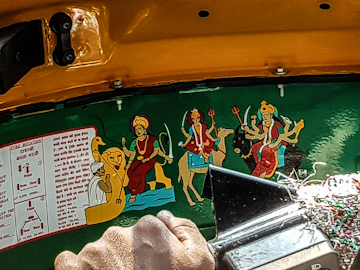
The best way to get around Baroda (now ‘Vadodara’) is by three wheeler autorickshaw (‘auto’). There are plenty of these nifty little vehicles for hire and although their drivers hardly ever use the meters, the fares are remarkably reasonable.

Unlike Bangalore, where the auto drivers are often argumentative and dodgy about fares, the drivers in Baroda are usually straightforward and friendly.

We have made a couple of long journeys in Baroda. As the auto drivers were uncertain about what to charge, they used their antiquated meters. These must have last been calibrated many years ago. According to such a meter, a journey of about 6 kilometres should cost 4 rupees and 20 paise. This is ridiculous because the shortest auto journey in Baroda costs 20 rupees today. The auto driver looks at his ancient meter and then, without looking at a conversion table, decides on a fee. We made the 4 rupee and 20 paise journey twice. Once, we were charged 100 rupees, and the other time 120. Both amounts are reasonable, and far less than you would pay in a Bangalore auto or a Bombay taxi.

I favour autos over cars for getting around cities in India. The former are far more manoeuvrable than the latter. This is vital in a city like Bangalore, where traffic is poorly managed. In Baroda, however, traffic flows brilliantly compared with Bombay or Bangalore.

Unless you have huge amounts of baggage, hop into auto in Baroda.
A globe trotting chef in Gujarat

So-called Italian food is popular in India. Indians are fond of pasta and pizza and are happy to eat almost anything that claims to fall into these categories. Often what is served as “Italian food” would be almost unrecognizable to Italians.

However, things are changing. Increasing numbers of Indians now visit Europe and many Europeans and Americans familiar with authentic Italian food visit India. They are more discerning than about the quality of Italian food served in India than Indians who have not been abroad.

Despite this, very few Italian restaurants in India are serving what I would consider Italian food like Mamma would make. Chianti Restaurant in Koramangala (south Bangalore) does makes the grade.

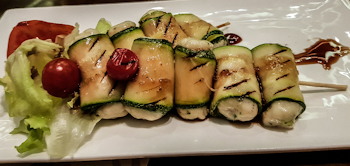
Tonight, I ate at Fiorella in the Alkapuri district of Vadodara in Gujarat. This Italian restaurant serves brilliant food. It is Italian food which makes no compromises to satisfy traditional Indians’ palates.

We met Ravichandra, Fiorella’s chef. He speaks Italian fluently, which is not surprising as he lived and worked in various cities in Italy for 14 years. He has lived abroad, mostly in Europe, for a total of 22 years.

He became a member of the Federation of Italian Chefs. He worked as a consultant advising the owners of Italian restaurants all over the UK. Spending 3 months in each restaurant, he helped their owners improve their establishments.

Following his return to India in 2008, Ravichandra, who was born in Kerala, worked in various hotels and restaurants before 2012, when the owner of the Express Residency Hotel in Vadodara asked him to set up Fiorella. The plan was to establish Fiorella as a totally authentic Italian eatery, whose food was not at all adapted to Indian tastes. This, Ravichandra has achieved most successfully. An Italian eating here would not be disappointed.

Two zoos

To date, I have visited two zoos in Gujarat: Junagadh and Vadodara. I have yet to visit a third, that in Ahmedabad.

The zoo in Junagadh is laid out over a large area of ground. Large animals and those which like to run around are in spacious enclosures. The zoo is pleasant to visit. It has wide paths, many of them with trees to provide shade.

Currently (January 2019), the zoo in the Sayajibaug Gardens in Vadodara is somewhat of a building site. This zoo is undergoing major rebuilding. The zoo is divided into three areas: birds, hippos and big cats, tigers and bears. There are also ponds containing crocodiles and alligators. The highlight of our visit to this zoo was seeing a new born hippopotamus with its mother.

The cages at the zoo in Vadodara are mainly very old fashioned. Hence, the building works whose aim is to create modern enclosures and a veterinary hospital.

I know that these days not everyone approve of keeping animals in zoos, but both zoos described above are well worth visiting.

Large snakes

The Laxmi Vilas Palace in Vadodara was built for the Gaekwad (Maharajah) of Vadodara in 1890 to the designs of the British architects Charles Mant and Robert Chisholm. It covers an area four times as large as London’s Buckingham Palace. This Victorian era Indo-Saracenic pile is now one of the main tourist attractions of Vadodara. What little of it that visitors are permitted to explore of this pastiche of various Asian and European architectural styles is overbearingly impressive but not of great aesthetic value.

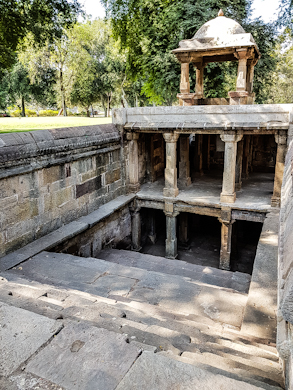
My main reason for visiting the palace was to see the Navlakhi Vav, a subterranean stepwell built in the 15th century. The stepwell has five levels of stonework galleries, all underground and one above the next. I was looking forward to exploring this, rather than the relatively uninteresting palace.

The official at the ticket booth for the palace compound told us that the ticket included access to the vav. He omitted to tell us that approaching this stepwell is now forbidden.

A security guard stands about 50 metres from the domes built above the vav. He told us that he would lose his job if he allowed us to go closer to the stepwells. Although his job was poorly paid, so he told us, it would be difficult for him to find another. He suggested that we returned to an office in the palace and spoke to a young lady whom we would find there.

When we explained my interest in stepwells to her, she accompanied us back to the guard, telling us that we could approach the outer walls of the stepwell but should not enter it. At present, she explained, the vav was not in good condition because stones kept falling from its structure. Additionally, the stepwell is currently infested by large snakes. She told the guard to take us to the structure. Although we could not enter the complex structure of the vav, we were able to see something of it over the low walls enclosing it at ground level. We could hear water splashing deep below us in the well in the deepest part of the stepwell.

The serpent infested vav is separated from where the guard stands by the tee of one of the 18 holes of the Laxmi Vilas golf course. We asked the guard whether the golfers, who had to stand close to the vav, were in any danger from the large snakes.

“No,” he replied in Gujarati, “they are not.”

“Why not?” we asked.

“Because they are members of the golf club,” the guard informed us.

Kites and cyclists

MAKARA SAKRANTI or UTTARAYAN, as it is known in Gujarat, is a Hindu festival held in mid January. It marks the beginning of the lengthening of day length, a month after the winter solstice.

Kite flying is a popular way to celebrate the festival. The kites are either attached to fine nylon strings or other threads sometimes covered with tiny fragments of crushed glass. Some kite flyers like to try to use their glass covered kite threads to sever the threads of other airborne kites.

The trees and ground are littered with paper kites that have escaped their owners. We have seen many of these in Vadodara.

Frequently, kites on long threads descend groundwards. The threads may cross busy roads. They offer danger to speeding motorcyclists. There is a real risk of drivers having their throats and faces severely injured by the almost invisible kite threads stretched across the road.

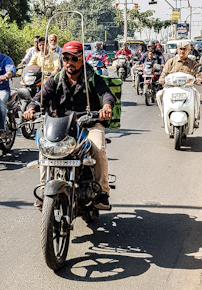
Prudent motorcyclists attach tall metal hoops from one handle bar to the other. These hoops will sever the hazardous kite threads before they can injure the cyclists’ throats.

Tea makers and politicians

Street tea making stalls are found all over India. They are great places for quenching your thirst and avoiding low blood sugar situations.

I am writing this during a visit to the Gujarati city of Vadodara, where we spoke to two tea makers this morning. One of them was a charming lady, who told us that she manned her stall from 630 am until 730 pm daily. She heats her tea on a gas ring. The gas cylinder contains enough gas for 15 days.

India’s present Prime Minister, Narendra Modi, worked briefly as a tea maker (‘chai wallah’) during his childhood. There is a chai wallah in Bangalore, whose shop is in Johnson Market. Not only does he serve excellent tea, but also he works as a local politician. He has his own party, whose symbol is a pocket calculator. He stands as a candidate in elections, but has never yet won any of them. He told us that if one chai wallah could become Prime Minister, there is no reason why another could not do the same.

Gopal , who has a tea stall near the entrance to one of the former pols* of Varodara, works from 10 am to 6 pm. His stall was very busy when we visited it this morning. It faces a peepal tree with numerous Hindu offerings around the base of its trunk. One of the daily offerings to the gods is the first cup of tea that Gopal makes each morning.

Like most other chai wallahs we have visited in Gujarat, Gopal adds fresh herbs and spices to his tea. Today, he had large sprigs of mint leaves and bunches of lemon grass and ginger. He pounds the latter in a pestle and mortar. He told us that pounding the ginger releases more flavour than grating it, which is what many chai wallahs do.

I asked Gopal whether I could take photographs of him and his stall. He allowed me to do so. As we were leaving him, he told his customers proudly (in Gujarati):

“Our Prime Minister has to go to the UK and USA to have his picture taken. See, people from the UK have come all the way from London to Vadodara to photograph me.”

* A pol is an ancient form of gated community, built for protection, found in the historic centres of Varodara and (more prevalently) Ahmedabad.

Providing for pigeons

In London pigeons are regarded as a nuisance, as pests. A previous Lord Mayor of the city once described them as “flying rats”. Now, feeding them is frowned upon. Gone are the days when you could buy corn to feed the pigeons in Trafalgar Square.

During our long journey through Gujarat in western India, we saw many places dedicated to feeding pigeons. In Bhavnagar, for example, I saw a man scattering seeds, which were being avidly consumed by a large crowd of grey pigeons. The grain was strewn over a large area in which there were several large bowls of water to quench the birds’ thirst.

In Ahmedabad, we saw a fenced off area supplied with drinking bowls as already described. This special feeding area was well supplied with grain scattered on the ground. In that same city, we saw a huge pigeon ‘hostel’. This consisted of a matrix of niches or pigeon holes in which the creatures resided. Feeding facilities were adjacent to the niches. This giant pigeon coop was next to a mosque or dargah close to the Nehru Bridge over the River Sabarmati.

In Rajkot, we spotted a cylindrical concrete pigeon coop mounted on a tall concrete pillar. And, in Porbandar a large area close to the beach is used to feed pigeons and other birds at the end of an afternoon.

During our very recent visit to the metropolis of Hyderabad in Telengana State, we have driven past pigeon feeding areas. On one of the bridges crossing the river, one of these feeding places occupied the whole length of one side of the bridge.

When wandering around the many bookshops in the Koti district of Hyderabad, we found a square surrounded by buildings. The centre of the square is a fenced open space where thousands of pigeons collect to feed on the copious amounts of grain on the floor. This area is overlooked by a cylindrical pigeon coop, which is illustrated above. The area is maintained by The Pigeon Welfare Association of Telengana.

The Lalbagh Gardens in Bangalore have at least one fine large cylindrical pigeon coop. I do not know how many other places in India care for pigeons as I the places I have mentioned, but from what I have seen so far, I can say that India is not devoid of popular concern for avian wellbeing.

An architect in Ahmedabad

There are many elegant moderns buildings in Ahmedabad designed by the architect BV Doshi. He worked with Le Corbusier in Paris. I feel that his buildings bear the sculptural influence of the famous French-Swiss architect, but they are far more user-friendly. We visited Doshi’s studio, Sangath Studio, in Ahmedabad in late March 2018…

doshi 1

The air temperature had exceeded 40 degrees Celsius when we arrived at the Sangath Studio, the offices of the architect’s firm led by BV Doshi. It is open for the public to view on guided tours conducted at 1.30 pm during the company’s lunch break. We were guided around the buildings by a young intern, not a trained architect. She explained to us that Doshi was influenced by what sounded to us like: “Lecobu and Lukhan”. What she meant was ‘Le Corbusier’ and ‘Louis Kahn’, whose buildings in Ahmedabad help make the city a ‘Mecca’ for enthusiasts of 20th century modernist architecture.

doshi 3

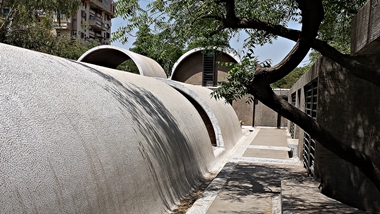
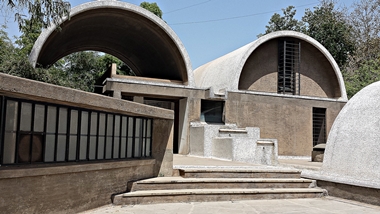
There were many architecture students and architects from other firms on our tour around Doshi’s studio. The students and architects asked no questions but made copious detailed notes. The architectural offices are set in a lovely luxuriant garden with piped music playing. The offices are beneath long white hemi-cylindrical concrete roofs, covered with irregularly-shaped white mosaic pieces like those on the outer surface of the Gufa, a man-made cave which he designed in Ahmedabad. The offices are below ground but lit from windows in the hemi-circular ends of the roofs. Unlike the Gufa, which is only suitable for artistic enjoyment, Doshi’s subterranean offices and studios are beautifully functional. Like Le Corbusier, Doshi designs using modular systems. This is exemplified by a conference room lined with cupboards and drawers whose dimensions vary according to a strict ratio. Doshi also plays with light and shade. Brightly lit rooms are separated by shady ones. The idea being that those who work and design with Doshi should be constantly aware of the importance of light and shade. Sangath Studios provides a visually intriguing and practical environment in which to work.


doshi 2

Statue of Unity: larger than life!

The Indian Government has just ‘unveiled’ the world’s largest statue, the Statue of Unity. It is 182 metres high and stands in Gujarat between Baroda and Ahmedabad. It is a memorial to Sardar Vallabhai Patel (1875-1950), who was born in Gujarat.

UNITY
Source: Wikipedia

A close associate of Mahatma Gandhi, Patel was a great fighter for India’s independence. When the British finally relinquished their hold over India on the 15th of August 1947, the territory of India was a complex mix of formerly British territory and the so-called Princely States, which were self-governing.

unity 1
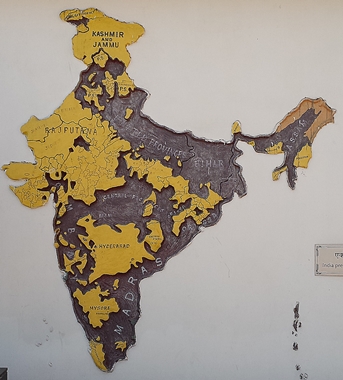
Map at Patel Memorial Museum in Ahmedabad. The yellow parts of the map show the parts of India occupied by Princely States

There were well over 500 Princely States embedded within the boundaries of what is now India. Over 200 of these were within the Saurashtra (Kathiawad) district of Gujarat. India in 1947 was a jigsaw puzzle of independent states each with their own ruler. These states were contained within a matrix that was formerly the part of India under direct British rule. After Independence, the rulers of the Princely States were given the choice of becoming part of India or joining the newly formed Pakistan.

Had the Princely States maintained their autonomy after Independence, the Indian subcontinent would have been as complex, if not more so, than the Balkans, and maybe as troublesome. Some of the states like Hyderabad and Junagadh, both large and far from Pakistan, had leanings towards joining with the new Islamic State of Pakistan. Others like Kashmir were not sure with whom to ally. 

It was the great skill and statesmanship of Sardar Vallabhai Patel that persuaded the Princely States to join India. Even Junagadh and Hyderabad were eventually incorporated into India. The unification of India was achieved under the leadership of Patel and his colleagues. So, it is fitting that the enormous new statue should be called The Statue of Unity.


unity 2
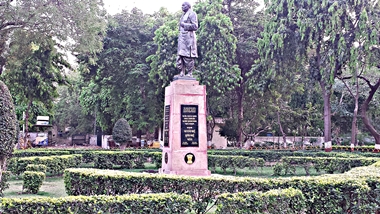
A modest memorial to Sardar Vallabhai Patel in central Ahmedabad

Whether Patel would have approved of the enormous expense involved in creating his latest monument, we will never know!