WHITE DESERT

THE WHITE RANN (desert) is so named because of the layer of white salt crystals that forms on its surface in dry weather. The salt forms when salty water covering the salt flats in Kutch evaporates. We arrived in the area of the White Rann a few days after a downfall of rain. Rain dissolves the salt and the whiteness of the Rann disappears.

One afternoon, I walked across the salt flats behind our hotel. The water on the distant lake shimmered in the bright sunshine. The flat Rann across which I was strolling was greyish yellow with occasional patches of white. The surface of the drying salt was crunchy underfoot and sparkled as the crystals reflected the sun light.

There was no one in sight, no birds or other creatures. There was no sound apart from a gentle warm breeze that was drying the salt covered surface of the completely flat Rann.

By now you might be wondering where all of this salt comes from. A long, long time ago, an inlet of the Arabian Sea separated what is now Kutch from what is now Sindh (in Pakistan). After some seismic activity, the sea bed of the inlet was transformed into a barren desert, the Rann of Kutch. During rainy season, water collects in lakes in the Rann. Salt from the former sea bed dissolves in the water. When this water evaporates in the dry seasons, the salt is precipitated on the shore when the waters recede.

In a couple of days time, the Rann will be snow white again providing there is no more rain.

Pink flamingos

WHEN I WAS A SMALL CHILD, I used to be taken to see the small menagerie at Golders Hill Park in Northwest London. In addition to wallabies and deer, there used to be, and it is probably still in existence, an enclosure containing a few flamingos. Until a recent visit to Mandvi in Kutch (Gujarat, India), these were the only flamingos I can recall seeing.

Every year, flamingos migrate to Kutch during the winter months to escape from the cold that affects their summer habitats during winter. They might fly in from central Asia, or from parts of India that get particularly cold in winter.

We were keen to see these flamingos in Kutch. A keen bird watcher, who lives in Baroda, told us that flamingos had been sighted at Modhva beach, a few miles east of Kutch Mandvi.

We drove to Modhva beach, arriving there about twenty minutes before sunset. At first, the only birds we could see were seagulls. There were no flamingos to be seen. We asked some local fishermen about them. They pointed at the sea.

Our driver, who must have keen eyesight, pointed at some specks on the surface of sea, maybe more than one hundred yards from the water’s edge. Using the twenty times optical zoom on my digital camera, I could see quite clearly that the specks were flamingos with pink and white plumage.

I managed to take a few photographs before the sun sunk rapidly below the horizon. I had seen flamingos in the wild for the first time in my life. It was an exciting experience.

HUMBLE BIRTHPLACE IN KUTCH

GUJARAT IS THE BIRTHPLACE of several great politicians of India: Mahatma Gandhi, Vallabhbhai Patel, Morarji Desai, and Narendra Modi, to name but a few. Kutch, which until soon after 1947 was an independent princely state, is now part of the State of Gujarat. It was the birthplace of an important, but now largely forgotten, ‘father’ of Indian Independence, Shyamji Krishnavarma (1857-1930).

The house in which Shyamji was born is the heart of the jumble of narrow streets in the old centre of Kutch Mandvi. Unlike the large house in Porbandar where Gandhi was born Shyamji’s birthplace is a very modest dwelling. Shyamji was the son of a poor man, who spent his working life struggling to make a living in Bombay.

We were shown around Shyamji’s birth house by Hriji Karani, who has not only founded a fine school in Mandvi but also instigated the creation of a monument to Shyamji at Kranthi Teerth.

The birthplace is now a museum, which is looked after by an elderly lady. In addition to caring fir the museum she helps her grandson and some of his friends with their schoolwork. Her grandson, aged only three, was able to speak a few words pf English as well as draw the Roman numerals on his slate.

The birthplace is devoid of household effects. Their pace is taken with exhibits, mainly photographs and paintings, relating to Shyamji’s fascinating life. Amongst the photos, there is one of the Middlesex Land Registry document relating to Shyamji’s purchase of a property in London’s Highgate, the building that was known as ‘India House’ between 1905 and 1910. This was the house where Shyamji and his ‘disciples’ including VD Savarkar plotted the downfall of the British in India. There was also a photograph of the block of flats in Geneva on which Shyamji spent the last few years of his life.

Shyamji and his wife died in Geneva. In his will, he had stipulated that his ashes were to remain in Switzerland and not to return to India until the land of his birth, India, became independent of the British.

Although India became independent, free of British domination, in 1947, it was not until 2003 that the ashes of Mr and Mrs Krishnavarma were brought to India. They were collected from Geneva by Narendra Modi, then the Chief Minister of Gujarat, and brought to India. I knew that from 2010, the black marble casks containing the ashes were put on display in a specially built pavilion at Kranthi Teerth, but I had no idea where they were kept before that.

Mr Karani showed us the small room in the birth house where the ashes were kept from 2003 until 2010. This little chamber, like the inner sanctum of a Hindu temple, now contains several photographs and a reproduction of an early flag designed for India by Shyamji’s feisty revolutionary colleague Madame Bhikaiji Cama and VD Savarkar during the brief existence of India House in north London.

A large oil painting depicts Shyamji with Henry Hyndman (1842- 1921), the British socialist whose anti-colonialist ideas strongly influenced Shyamji and his followers. Hyndman delivered a speech at the opening of India House in 1905. In the background of the painting there is a portrait of BG Tilak (1865-1929), one of the most revolutionary of the earliest members of the Indian National Congress and can well described as ‘the father of Indian independence’.
Like many other traditional houses I have visited in Kutch and Gujarat, the wooden staircase leading to the upper storey is incredibly steep, almost a ladder. The upper storey of Shyamji’s birthplace was a single room with more photographs and a tiny balcony that provides a view of backs of the houses on the street below.

Shyamji left Mandvi to study in Bhuj and then Bombay before setting off for England where he became a barrister in London and a world expert in Sanskrit based at Oxford. It is unlikely that he visited Mandvi much after beginning his impressive career. I have described the remarkable life of this son of Mandvi and esrly advocate of Indian independence in my book, “IDEAS, BOMBS, and BULLETS”

Although I knew that Shyamji was born in Mandvi in a far from well off family, and I had already visited the town once before, seeing his actual birthplace, viewing its surroundings, and entering his childhood home helped me appreciate the ‘rags to riches’ aspect of his life.

IDEAS BOMBS AND BULLETS by Adam Yamey describes the life of Shyamji Krishnavarma and the centre for Indian freedom fighters that he created in North London. It is available from:


Lulu.com
Amazon
Bookdepository.com
Pothi.com (best place to purchase it if in India)
Kindle

A mosque in Ahmedabad and Hindu temples

DURING VARIOUS VISITS TO AHMEDABAD, we have often driven past the Ahmed Shah Masjid, but never visited this venerable mosque. Close to the great Bhadra Fort and built in about 1414 AD by Ahmed Shah, the founder of Ahmedabad, this is the oldest extant mosque in the city. Today, we entered this exquisite mosque and its garden and discovered a perfect example of Indo-Islamic architecture.

When this mosque, and many others built in western India up to at least a century later, was constructed its creators incorporated many design features that can be seen in Hindu and Jain temples that were constructed centuries before believers of Islam entered/invaded India.

The grounds of the Ahmed Shah Masjid are entered through a small stone pavilion. The step inside it is just like the entrance steps to Hindu and Jain temples in that it includes a centrally located semicircular projection.

The patterning on the exterior stonework of the mosque and the many pillars within it would not look out of place on pre Islamic places of worship in India. However, the presence of figurative carving found in Hindu and Jain temples is completely absent in mosques. One small exception, which I saw at the Ahmed Shah Masjid and others in Ahmedabad, are carvings of trees, the Tree of Life.

The Ahmed Shah mosque and many other medieval mosques in Gujarat are topped with numerous domes. Seen from the outside of the mosques, they do not look exceptional, but viewed from within, the influence of Hindu/Jain temple architecture is obvious.

The domes are usually supported by 8 pillars arranged as a regular octagon. Neighbouring pillars support horizontal lintels, which together form an octagon. The dome rests on these lintels. The internal surfaces of the domes, when seen from below, consist of a series of concentric rings that decrease in circumference as they approach the top of the dome. The stonework of the rings can be either plain or elaborately ornamented. The design of these domes and their supporting supporting pillar systems are identical to what can be seen in Indian temples built long before Islam arrived in India.

Unlike the non-Muslim temples that inspired their design, medieval mosques contain features that are unique to mosques, such as elaborately decorated mihrabs, niches in the wall of the that worshippers face when they pray.

The Ahmed Shah mosque has an elevated internal chamber, where the king could pray separated from the rest of the congregation.

Having at last visited this fascinating mosque, I would reccomend all visitors to Ahmedabad to visit it first before exploring the other wonderful 15th and 16th century mosques that enrich the city.

The Ahmed Shah Masjid is a fine example of how conquerors can be conquered by the culture of those whom they have invaded. Just as the Muslims were bewitched by the wonders of Indian culture, so were the British many years later, as well exemplified by the Brighton Pavilion.

In the footsteps of the ancients at Lothal

OSTIA ANTICA, THE PORT of Ancient Rome is constructed mainly with baked clay bricks. When I visited it some years ago, I remember thinking that it looked like a recently built place because of the brickwork that looked so contemporary. Ostia dates back no further than the 4th century BC. The port at Lothal in Gujarat (western India) thrived long before Ostia, probably between 2500 and 1900 BC, but like the Roman port, the remains of Lothal are mainly (sun baked) clay bricks, giving them a far from ancient appearance. Lothal, excavated in the 1950s, was a port inhabited by people of the Bronze Age Harrapan (or Indus Valley) civilisation that thrived between about 3300 to 1300 BC.

We drove to Lothal from Ahmedabad along a good highway that runs through flat landscape with numerous tidy looking factories. We arrived after about 75 minutes of steady driving. The archaeological site, maintained by the Archaeological Survey of India (ASI), is in the middle of very flat fertile agricultural land far from the nearest village. Unlike most other ASI sites that charge an entrance fee, that at Lothal is the same for both foreigners, who are usually charged a high fee and Indians. Each ticket cost only 5 Rupees.

The ticket gives access to a small but well laid out museum, whose exhibitsand information panels demonstrate how Lothal fits into current understanding of Harappan civilisation and what life might have been like in the ancient port. A fairly simplistic video was shown. It concentrated mainly on Mohenjo-Daro, a large Harappan site now in Pakistan. The evidence dug up at Lothal and other Harappan sites shows that the civilisation was both technically and artistically sophisticated. On display, were systems of weights and ingeniously crafted fine jewellery, both examples of products that could only have been produced by people of great intellectual ability.

The ruins are, as already mentioned, mostly made of brick. A low mound, known as the ‘Acropolis’, is covered with structures that might have been warehouses or residences of the upper echelons of Lothal. The mound overlooks what looks like a huge rectangular brick lined swimming pool, now filled with rainwater. When Lothal was thriving, this dock was connected to the nearby sea (now the Gulf of Khambat) by a channel along which vessels could sail. Over the millennia, the coastline has shifted and what was once Lothal is separated from the sea, far away from it. The ASI keep the dock filled with rainwater to show what the dock must have looked like in its heyday.

Various other structures outlined by brickwork, including circular wellheads, can be visited. These include the former bead factory, a cemetery (where all the skeletons discovered were from people who died aged 30 or less; maybe older people were cremated), and a ‘lower town’. What little that has been excavated is well looked after, but without the explanations provided in the museum the casual visitor would have no idea of what he or she was seeing or how ancient these remains are. With a little background information it was thrilling to walk in the footsteps of townsfolk and traders who lived and thrived so many, many years before us.

We met only three other visitors while wandering around the ruins. They were all from Bangalore. They were touring Gujarat but lamented the fact that most signs are only in Gujarati script. In Karnataka, where they live and where we visit often, signs are often not only in the local script but also in English and/or Hindi.

There are no refreshments available at the Lothal site. An employee suggested that we might get tea in the modern village of Lothal, a few kilometres away. Our driver had his doubts about this and so did I when we drove along the winding dusty road through the small village. There were no shops or stalls to be found.

We parked outside a pair of wrought iron gates separating two houses. A lady appeared in the door of one of them, and my wife asked (in Gujarati) whether tea was available in the village. The lady said she would make some for us.

We followed her through the gates and into a long wide alley lined with houses. Two ladies were embroidering gold thread, jewels, and sequins onto long silk saris spread out along the incredibly clean concrete floor of the alley. Other ladies were sitting around.

Our hostess brought us each a plastic chair from her home. We sat chatting with the ladies while we awaited our tea. The alley was lined with houses that a farmer had built for his sons. Each of the ladies was one of his daughters in law.

Our hostess arrived with a large metal cup filled with tea and two china saucers. Each of us was handed a saucer, which she filled with hot tea. We slurped the tea from the saucers as is the custom when sharing tea in Gujarat (often one person drinks from a cup and the other who is sharing it drinks from the saucer: a system known as ‘cutting chai’).

The ladies doing the embroidery take about a day to decorate a whole sari with a complex design. The silk is sent to Lothal from Surat, where the decorated saris are later sold. An old lady with barely one tooth in her smile, the mother in law of the women we were talking with, joined us. This wizened relative asked if it was true that a man’s haircut would cost 1000 rupees in the USA, as she had seen on YouTube. We told her that it would cost at least that. She was then told to go back to rest on her charpoy in the nearby farmyard.

We asked where the menfolk were. They answered: “In the fields. What else could they be doing?”

Our hostess, who seemed to be the brightest of the very hospitable women, took us to see the cow whose milk had been used to make our tea. We thsnked her calf for sharing his mothers milk. She also proudly showed us the two fine horses the family owned.

Just before we left, my wife asked our hostess whether we could leave a small gift for her children. She said that they were at school and there was no need for a gift. She told us that she was very keen that they should do well at school, and hoped that they would be able to study in the USA, because she said: “There is no future for them, nothing here anymore.”As we drove away from our new acquaintances through the village, people waved to us. We waved at three old men on a bench. They waved back. We felt that we had received a warm welcome at ground level in Gujarat.

Flying high above Ahmedabad

Today, 7th January 2020, we bought tickets for onwards bus journeys at Ahmedabad’s Geetamandir bus station. The young man at the ticket counter was an excellent salesman.

We stopped at the Raipur Gate, one of the several gates on the now demolished city wall. Only the gates remain as mementos of this wall.

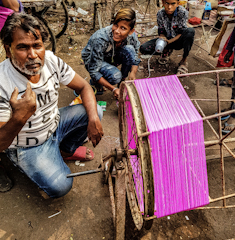
Next to the gate, there were several spinning kite cord winders. They were preparing the cords that would be attached to the kites flown to celebrate the festival of Uttarayan (end of winter), which is celebrated all over Gujarat.

White thread is fed through a basin of coloured dye and then coated with finely ground glass and glue before being wound onto large spinning bobbins. The thread, when dried, is wound onto smaller bobbins that are sold to kite flyers. The ground glass is added to the thread so that kite flyers can use their kites to cut through the strings of other kites while they are airborne. The men making the threads were kot Gujaratis, but from outside the state, from Bihar and UP fir example.

Ahmedabad now hosts an annual International Kite Festival.

The kites, made mostly of paper, are sold along a street leading away from the Raipur Gate. Kite flyers need to buy their kites and reels of thread (to attach to them) separately. We spotted numerous small stalls selling adhesive tape. One of the vendors of these explained that pne wraps this tape around fingers to stop them being injured by the very abrasive glass coated kite threads. Masks were also on sale. These are worn during the kite festival.

When we asked someone where we could watch the kites being flown, we were told: “In the air, up in the sky”. On further questioning, we were told, as if we were idiots, that the kites can be seen flying in the heavens.

Some years ago we visited Ahmedabad in late March. Even so long after Uttarayan, the branches of trees were filled with the remains of kites that had been caught in them.

The man who created a united India

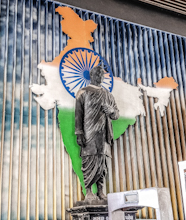
Without Vallabhbhai (‘Sardar’) Patel (1875 -1950), the map of post independence India might have looked quite different. Patel was born in Nadiad, Gujarat and died in Bombay soon after completing his arduous task of encouraging the former princely states to become parts of a united India. The statue of Patel shown above stands in the Geetamandir bus station in Ahmedabad.

HAPPY NEW YEAR!

An afternoon in Ahmedabad

FAMILIARITY BREEDS … CONTENTMENT. We have just landed in Ahmedabad. It is our third visit to this city in Gujarat within less than two years. We received a warm welcome from the staff at the small hotel where we have stayed twice before.

After settling into our room, we ate a good meal of Mughlai food at the Food Inn, which is opposite the 16th century Sidi Sayeed Mosque. Then, we travelled to the Gita Mandir bus station, where a very helpful booking clerk arranged tickets for various intercity trips we are planning to make soon.

The noisy, bustling traffic in Ahmedabad is typical of the city’s general feeling of vibrancy and exciting vitality. So bad was the congestion on the roads that our autorickshaw driver suggested that we abandoned our plans to visit the Jumma Masjid near the Manek Chowk. He explained that being the 30th of December, everyone was in a holiday mood and out on the streets spending money.

We disembarked at Khwaja Bazaar, a frenetic market place between the three arched Teen Darwaza and the Badra Fort, where the early rulers of Ahmedabad had their headquarters. We strolled along a street leading away from the market, admiring occasional old looking buildings along it. I imagine that the oldest of these is about a hundred or so years old.

Eventually, we reached a post office just across the road from an ageing Parsi ‘dharamshala’. Apart from a vigilant watchman, who looked at us suspiciously, the place looked rather dead. We took tea at a pavement stall. Typical of the kindness of people in this city, the ‘chaiwallah’ specially prepared tea without sugar for us instead of the very sweet beverage that is usually served. We sat on a bench, sipping tea and watching the world go by. It felt good to be back in Ahmedabad, a city, where kite flying is a popular pursuit. A city that is becoming familiar to us and makes us feel content.

Three-wheelers in West Bengal

A toto

A fohtfohti which resembles a chagda

In the Saurashtra region of Gujarat, there are many chagdas, which are also known as ‘ta tas’. They consist of the front half and engine of a motorcycle and the rear half can be either a passenger compartment or more often a wagon for carrying goods.

Way over east in Shantiniketan (West Bengal) I spotted two kinds of three wheelers, which resemble, at least superficially, the chagda.

The ‘toto’ has the handlebars and front appearance of a motorcycle and the vehicle has a passenger compartment. The totos are very silent because they are propelled by electrical energy.

The ‘fohfohti’ which is used to transport freight is just like the chagda seen in Saurashtra. It is propelled by a motorcycle engine and its front half, like the chagda, is the front half and engine of a motorbike.

Gandhi and Savarkar in north London

KRISHNAVARMA COVER BOOK BY HITESH BHANUSALI


MK (‘Mahatma’) Gandhi, born in Porbandar (Gujarat) visited London in 1906. He spent the first two days of his stay at India House, the hostel in Highgate founded in 1905 by Shyamji Krishnavarma (born in Kutch, now part of Gujarat).  Gandhi did not see eye to eye with Krishnavarma and Vinayak Damodar Savarkar, who was living in India House. These extracts from my book “IDEAS, BOMBS, and BULLETS” describes Gandhi’s meetings with Krishnavarma and Savarkar.


Extracts

During October 1906, India House received one of its most well-known guests. On the 20th of that month, MK Gandhi arrived at Waterloo Station, having recently disembarked from a ship that had carried him from South Africa. He was met by the father of Henry Polak (Gandhi’s South African associate), Lewis Ritch, and others of his followers. They travelled together to India House, where Gandhi spent two nights. After that, he moved to the now long-since closed luxurious Cecil Hotel, which used to stand in the Strand. During his stay in London, he attended at least three of the Sunday evening meetings held every week at India House. These meetings were to discuss matters connected with India, to celebrate Indian festivals, and to allow Indians in London to socialise…

… Savarkar was not friendly to Gandhi when he visited India House in 1906. He strongly disapproved of this visitor’s thoughts and actions throughout his life. It is said that on one of Gandhi’s visits to India House, Savarkar, who loved prawns, offered some to the vegetarian visitor, who politely refused them. Savarkar said to Gandhi:

Well, if you cannot eat with us, how on earth are you going to work with us? … this is just boiled fish … we want people who are ready to eat the Britishers alive…”

Incidentally, Shyamji Krishnavarma was, like Gandhi, a strict vegetarian. He preferred cooked food and had his favourite food, mung dal (a lentil preparation), sent from India. Also, he avoided onions and chillies. Regarding food at India House, especially as it reached its final year, Asaf Ali wrote:

Within a fortnight of our stay in India House, Rauf [Ali’s brother] and I decided to move out of it. For here food served there defied description. And here were Madrasis, Mahrattas, and Punjabis, each so far apart in tastes…”

Gandhi had not come to Highgate to discuss eating habits with the young revolutionary Savarkar. The future Mahatma, who had praised the work of Shyamji, wanted to confront and argue his case with Shyamji, who had been very critical of the assistance that he had offered the British during their war with the South African Boers.

On one of his visits to India House (Sunday 21st October), Gandhi spent the whole day there. During the day, he spent time talking to young Indians. In the evening, he spoke with Shyamji. One of the matters that particularly concerned Shyamji was the forthcoming election of the President of the Indian National Congress. BG Tilak, whom Shyamji admired, was one of the candidates. The ‘moderate’ Indian nationalists favoured Dadabhai Naoroji. Shyamji tried to persuade Gandhi to dissuade Naoroji from standing. However, Gandhi felt that Naoroji was the right man to be President. In November 1906, Shyamji wrote an article in Indian Sociologist, condemning Naoroji. He made comments such as:

We have ample evidence to show that Mr. Dadabhai Naoroji is ever ready to oblige his Anglo-Indian friends at the cost of his country … Mr. Dadabhai is allowing the great reputation he made in the past to damp down the aspirations of the Indians of today … How long does Mr. Dadabhai Naoroji expect that the Indian people will continue to be hoodwinked by him?

Three years later, Gandhi published a booklet called Hind Swaraj. It was, in part, a thinly veiled criticism of the extremists like Shyamji and Savarkar.


End of extracts


IDEAS, BOMBS, and BULLETS” by Adam Yamey may be bought here:

https://www.bookdepository.com/IDEAS-BOMBS-BULLETS-Adam-YAMEY/9780244203870

AND here:

https://www.amazon.com/IDEAS-BOMBS-BULLETS-Adam-YAMEY/dp/0244203873/

Also on KINDLE

And (in India only):

https://pothi.com/pothi/book/adam-yamey-ideas-bombs-and-bullets


Picture shows Krishnavarma on a book by Hitesh Bhansali