A freedom fighter from Kutch

VARMA HOUSE

Shyamji Krishna Varma (1857-1930) was born in Mandvi in Kutch (now part of Gujarat State). A Sanskrit scholar of world reknown and a barrister, he was also an important, but now not so well-known, activist in the fight for India’s Independence from the British. 

He settled in London in the late 1890s and lived there in the northern suburb of Highgate until he moved to France before 1910. This house, number 60 Muswell Hill Road, was his home between 1900 and 1907. A circular plaque commemorates his short stay here.

An Albanian in Gujarat

While visiting the former Portuguese colony of Diu, an enclave on the south coast of the Saurashtrian peninsula of Gujarat, I came across an open space that provides great views of the fortresses.

DIU MON

It contains a tall, bulky, four-sided column with longitudinal striations. Wire hoops serving as simple steps provide a means of reaching the column’s flat square summit. This is a monument built by the Portuguese to honour of the Gujarati General Khadjar Safar (known by the Portuguese as ‘Coge Cofar’).  The Gujaratis and the Portuguese were enemies and a siege occurred in 1546. This siege of Diu was won by the Portuguese, but Safar was remembered for his bravery. I have seen a picture of this column taken in the 1950s, when it bore a plaque in Portuguese that read in translation: “The tomb of Coge Cofar, instigator of the second siege of Diu. Commander-in-chief of the Turkish and Janissary troops from the kingdom of Cambaya, imposers of the siege of this Fort. In May of the year of 1546, he was killed by a stray bullet that came out from the Fort, penetrated the Turkish forces, and blew off his head. He was brave and courageous.”

Kuzhippalli S Mathew writing in his Portuguese and the Sultanate of Gujarat, 1500-1573 relates that Khwajar (or Khadjar) Safar was born in Italy of Catholic parents, probably Albanians. A successful trader, Safar, with his three boats loaded with valuable spices and drugs, was captured by a general of the Sultan of Cairo, who encountered him in the Straits of Mecca. The captive so impressed the Sultan that together they began planning ways to oust the Portuguese from the Indian Ocean trading arena. Portugal’s activities were wrecking the import of spices to Europe via Egypt. The Sultan gave Safar command of vessels to attack the Portuguese in India. By 1508, he had already fought with the Portuguese near both Chaul and Diu. After many adventures amongst which he fled from Egypt, converted to Islam, and even served the Portuguese briefly, he became an important person in the Sultanate of Gujarat. Both Khadjar Safar and his son Muharram Rumi Khan were killed during the siege of 1546.

This is an excerpt from Travels through Gujarat, Daman, and Diu by Adam Yamey.

Available from Lulu.com, and on Amazon Kindle

Ellis Bridge

Ahmedabad was founded on the east bank of the River Sabarmati in the 15th century. Until 1871, there was no bridge across the river from the city to the west bank. In that year, a wooden bridge was constructed.

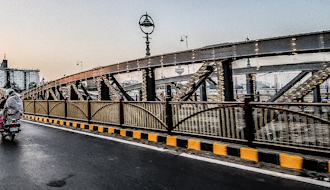
A few years later, the wooden bridge was destroyed by floods. In 1892, a steel bridge was constructed. This was designed by an Indian engineer HD Bhachech and named in honour of a British colonial official named Ellis.

The Ellis Bridge remained in use until 1997, when it was closed. By 1999, two concrete bridges were constructed, one on each side of the old bridge. These new, wider bridges form what is now known as the Swamivivekananda Bridge. The old Ellis Bridge flanked by the two concrete bridges, heavily laden with traffic, has been preserved as a heritage monument.

The old Ellis Bridge, which existed when Gandhi returned to India from South Africa in about 1917, leads from the old city to Kochrab, where the Mahatma set up his first ashram in India.

Spotted in Bhavnagar

Mahatma Gandhi studied for a few months at Samaldas College in Bhavnagar. The Gandhi Smruti in that city contains a first class collection of photographs recording the life of the Mahatma. This echibition is on the first floor of a building. Its ground floor is occupied by the exhibits in the city’s Barton Museum.

The Barton contains some fine artefacts made in different eras. Amongst these, there are some lovely Jain stone carvings.

One area of the museum oncludes a case showing the evolution of the flag of what was to become post-colonial India. Near to this, there is a vitrine containing ageing historic postage stamps in various states of decay.

While looking at the stamps, I spotted several bearing the name “Ifni”. Never heard of it? Well, I had. I used to spot Ifni on the pages of atlases published before the 1960s. However, I had never seen stamps bearing this name.

Ifni was a tiny Spanish colonial enclave on the Atlantic coast of Morocco. The Spanish ruled Ifni from 1860 until 1969, when it was returned to Morocco. The Sultanate of Morocco had ceded the tiny piece of land to Spain in 1960.

According to an article in Wikipedia, Ifni issued several new postage stamps each year. More of them remained unused than used.

I do not know who donated the sheets of postage stamps to the Barton Museum in Bhavnagar, but those from Ifni were certainly isdued orior to 1969.

The museum in Bhavnagar is, like many other museums in provincial towns in Gujarat, filled with a variety of artefacts. You never know what you will find when you enter one of them. The stamps from Ifni were certainly unexpected.

Feeding the poor

A few years ago, I was on Calcutta during the August monsoon. As I waded through the filthy rain water flooding the streets of a bazaar area, I noticed that at quite a few clothing material shops run by Moslems there were huge pots of rice and dal or curry. These were manned by shop staff. They were doling out this food to various poorly clothed passers by.

I asked what was going on. One shop keeper told me that during Ramadan it was considered virtuous to feed the poor while the faithful Moslems upheld their required daily fasting. This charitable activity impressed me.

During a recent visit to Ahmedabad in February, I passed an eatery, whose signboard read Muslim Kifayat Hotel, hotel being Indian English for restaurant.

Kifayat is the Urdu word for ‘sufficiency’. It may have other meanings in Hindi.

The restaurant under discussion is on one side of the enormous market place that extends from the Bhadra Fort through the three arches of the 15th century Teen Darwaza and beyond.

Rows of benches are lined up on the pavement in front of the open fronted restaurant. Often, these are occupied by people, who appear to be extremely impoverished. Food (all vegetarian) is prepared at the front if the restaurant in huge pots and a tandoor oven.

One of the men running the Kifayat Hotel explained that the meals they served – dal, rice, freshly cooked rotis, and vegetables – are normally priced at 40 rupees, but poor people pay no more than half of that amount.

Later while exploring Ahmedabad we spotted other eateries like the Kifayat Hotel, and like that place they had rows of benches in front of them. Often, these seats were quite crowded with men, women, and children.

I have yet to discover whether the charitable eating places we saw on Ahmedabad are self-financing or to some extent assisted by charitable institutions.

P.S. just before publishing this, I visited a Hindu temple in Koramangala, Bangalore. Every Thursday, lunch is provided free of charge to anyone who turns up, regardless of their religious belief.

A peculiar street object

Happy Valentine’s Day!

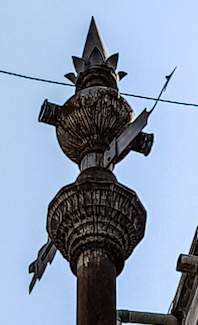
In the historic centres of both Ahmedabad and Baroda (Vadodara), there are a few very tall, several storeys high (higher than the buildings next to them), metal poles sprouting from the pavement. They are all topped with metalwork objects as illustrated in my photograph published below.

Most people, whom I asked, had no idea what purpose these poles and their curious apparatus served. I posted pictures of these tall poles on Facebook, and then received a number of suggestions as to what they might be. Most people, seeing the arrows, suggested that they may have been old weather vanes for determining wind direction, but I felt that this was an unlikely for these poles that look as if they were put up by a municipal authority.

One person I asked in a street in Ahmedabad thought that the poles had something to do with drainage, maybe ventilation. I quite liked that speculative reply because the spheres surmounting all of the poles have two short pipes attached to them.

Recently whilst looking at the Internet I came across a picture (see https://www.arcgis.com/apps/MapJournal/index.html?appid=4c10a18d5cfa4da486df492765c2ad54) like mine. The picture was taken in Ahmedabad and is described as a sewage gas vent. This tallies with what I was told by one bystander.

A sewage gas vent that might have rotated to catch the prevaing breezes seems to be a plausible function for these poles BUT I cannot yet be sure if this is correct.

If anyone reading this can enlighten me more, please drop me a line or two in the comments section of this blog.

Coin and note

Currently in India, there is both a coin and a banknote worth ten Indian rupees. The banknote exists in two different designs, old and new, both legal tender at the moment.

In Gujarat, we found that no one objected to using both the coin and the banknote. In Bangalore, in the south of India, we hardly ever see the 10 rupee coin.

Drivers of autorickshaws in Bangalore refuse to accept the 10 Rupee coins, but shops will take them.

We were told that the autorickshaw drivers will not take the 10 coins because they are too heavy! Yet, they happily accept 1, 2, and 5 rupee coins.

Curious, isn’t it?

Traditional and trendy

We have made many journeys on intercity public buses in Gujarat. Most buses, especially the ones operated by private companies, pick up passengers at rural locations along the route.

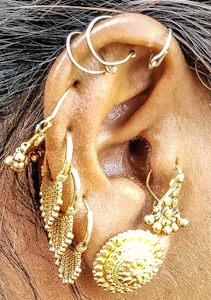
Many of these passengers in rural areas wore traditional costumes typical of the area where they lived. In Saurashtra, many of the women wore tight fitting backless choli (blouse), which are covered by shawls that fly about as draughts are created by the moving bus. Their ears are often festooned with weighty and often complicated solid gold jewellery. They are usually heavily tattooed, with tattoos placed on all parts the body that were visible.

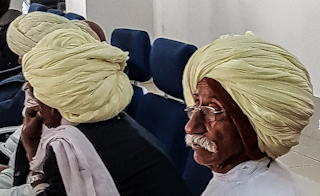
The men who board the buses at rustic spots are usually dressed in white kurtas with white jodhpurs: loose fitting baggy trousers, which are tight around the ankles. I write “white” but these clothes are often stained, the result of working in the fields. These men, often with weather worn faces, wear turbans, which to my western eyes, makes them look quite exotic.

At first, when I saw these country folk boarding the bus, I felt that they looked as if they were stepping out of the Middle Ages and into the 21st century.

Despite their clothing, these country passengers are extremely up to date. Almost as soon as they have found somewhere to sit or stand in the often overcrowded buses, out come their mobile phones. I am not sure where the men store their phones, but the women keep them and their cash stuffed within the tops of their choli close to their breasts.

The close juxtaposition of tradition and modernity is one of the many aspects of India which endear me to the country.

An art bookshop in Ahmedabad: Art Book Center

This small gem of bookshop in Ahmedabad is a wonderful discovery. It was recommended to us by Mr Shukla who is the General Secretary of the Ahmedabad Textile Mill Owners Association, which is housed in a masterpiece by the architectural genius Le Corbusier.

The bookshop, a true life Aladdin’s cave, is on the first floor of a residential building. It is reached by a steep ladder like staircase typical of those found in houses all over Gujarat. The steps lead to a balcony which is festooned with colourful folkloric items. A doorway leads from there into the shop itself.

The walls of the small, cosy shop are lined with neatly stacked book cases. Piles of books rise from the floor. On the walls and in between the book cases, there are numerous folkloric artworks and practical items including beautifully embroidered and printed textiles. We were welcomed by Manarbhai and Ketan, one of his two sons. They invited us to sit down.

Manarbhai worked for many years as a typist in the Mathematics Department of the University of Gujarat. He was no ordinary typist. He was able to type mathematical equations, which was no easy feat in the era before computerised word processors became available.

Manarbhai began his book business as a part time enterprise. In 1970, he converted part of his home into what is now his shop. At first, he only opened his shop on weekends. Now, it is open every day between 10 am and 6 pm.

The shop specialises mainly in books on art and architecture. It contains many books about textiles. Many of the volumes available are rare editions. If what you wish is not stocked, Manarbhai and his sons will do their best to source it, and then send it to you anywhere in the world.

It soon became apparent to us that Manarbhai and Ketan are extremely knowledgeable about books in the fields on which they specialise. They are also sensitively intelligent salesmen. Very quickly, they assessed our particular interests and began showing us books that were in harmony with them. We came away with a valuable selection of books that will help satisfy our curiosity about the fascinating history of the city of Ahmedabad.

This is a bookshop for true book lovers and collectors. It should be on every bibliophile’s itinerary. What Manarbhai cannot find for your bookshelf is probably not worth having.

Address: near Jain Temple, Madalpur, Ellis Bridge, Ahmedabad 380006

Side steps

Here is something I first noticed when visiting the temple town of Somnath: side steps. I have seen better examples of what I am about to describe in Ahmedabad (see photo).

Staircases take up space. In many older Gujarati buildings, internal staircases are so steep that they resemble ladders. Good examples of these may be seen at the birthplaces of Mahatma Gandhi and his wife in Porbandar.

External staircases linking raised entrance doorways to the street sometimes require many steps. If the treads of the steps are parallel to the external wall, a large staircase would have to project far into the roadway, restricting the usable width of the latter.

One solution to reducing the footprint of an external staircase is often adopted in Gujarat. That is to make the treads of the steps at right angles to the external wall rather than parallel. This works well, and reduces the encroachment of private front staircases onto the public thoroughfare.