Flying into Kutch

Kandla


A quick way to get from Bombay to Kutch is by flying. There are two airports in Kutch where passenger ‘planes can land: Bhuj and Kandla.

We took the one flight a day from Bombay to Kandla on the  coast of Kutch. As the ‘plane descends towards Kandla, it flies over a vast area of marshy coastal inlets that surround the seaport. When we landed, we walked down the ladder onto the tarmac, I noticed that the propellor ‘plane was surrounded by soldiers armed with machine guns. The reason for this is probably that Kandla airport is primarily a military aerodrome. Ada, also, Kandla is just over 200 kilometres from India’s border with Pakistan.

We walked towards the small terminal building followed by our baggage that was carried in small wagons joined together like a train and pulled by a little tractor. At the terminal, we had to help ourselves to our baggage before being hurried into the carpark outside the airfield. It was clear that passengers are not particularly welcome at this militarily sensitive area.

Buddhist carvings

Buddhist

About 10 kilometres south of the small town of Virpur in Saurashtra (Kathiawad), a short distance from the main road connecting Virpur with Junagadh, lies the archaelogical site of Khambalida. It was there that archaelogists discovered some Buddhist rock temples in 1958. These temples, which overlook a river bed, carved from the ‘living rock’ date back to the 4th to 5th centuries AD. Though slightly weathered, these fine carvings are in pretty good condition.

Other Buddhist carved caves can be seen in Gujarat at Junagadh and near Somnath. 

No outside food

Often there are signs in India forbidding customers from bringing outside food into restaurants. In the UK, this is less common…

yamey's avataryamey

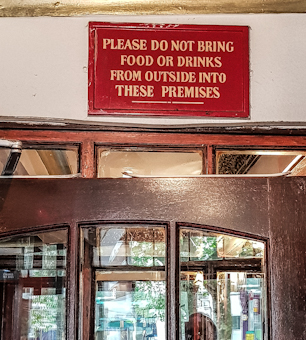
The Coffee Cup café in London’s Hampstead has been in business since 1953, and has been very popular since I first remembered it in the early 1960s. I have visited it several times, but never before noticed the sign at its entrance, which reads: “Please do not bring food or drinks from outside into these premises.” This instruction is not seen frequently in restaurants and cafés in the UK. Seeing this sign reminded me of what is very common in eateries in India, namely, signs reading: “Outside food not allowed.” Customers are forbidden to bring into the estblishment food or drink they have obtained elsewhere. That is fair enough, I suppose.

Cinemas in India, like in many other countries, try to sell food and drink to their customers, often at outrageously high prices. Apparently, watching a film is for many people more enjoyable if you are…

View original post 234 more words

Wood carving in Ahmedabad

POL

The old part of the city of Ahmedabad is divided into self-contained districts, like gated communities, called pols. Each pol has its own single gated entrance which gives sole access to a number of narrow streets. The narrow streets are lined by tall buildings, which together render the temperature of the pols at ground level far lower than the temperature in wider streets and open places in the city.

In times of trouble and strife, the gates of a pol can be closed to prevent intruders entering it. Secret passages lead from one pol to its neighbour(s). Pols have their own wells. 

Often a pol is inhabited by families that have something in common, for example religion, caste or profession.

One of the many delights of the pols in Ahmedabad (they are also found in Baroda) is that they often contain buildings decorated with intricately carved woodwwork decorative and stuctural features.

For tourists, a pol is not only a place that they can literally ‘chill out’ but also they can experience a valuable part of Ahmedabad’s living history.

Art school in Baroda

BARODA ART


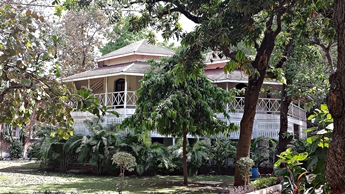
This lovely old building surrounded by trees and other luxuriant vegetation stands on the campus of the Faculty of Fine Arts of the Sayajirao University of Baroda (Vadodara).

Here is an excerpt about this place from my book “Travels through Gujarat, Daman, and Diu”:

In 1935 to celebrate the diamond anniversary of his reign, Maharajah Sayajirao III Gaekwad set aside huge funds, both the state’s and his own, to create a university in Baroda. The Faculty of Fine arts, set in park-like grounds with many trees, is a part of this. The campus contains several buildings. The most attractive of these is an almost octagonal building surrounded by deep verandas with wooden balustrades at both ground floor and first floor levels. This building, which contains some studios, was constructed in the 1930s. Other buildings on the campus are newer, having been built after the Fine Arts Faculty was founded in 1951.

One of the joys of art schools in India, and that in Baroda is no exception, is watching students creating artworks in the open air, and seeing their completed creations exhibited outside. Many of the works on display demonstrate the great technical skills and lively imaginations of their creators. We saw many youngsters sitting in the shade of the trees, at work in their sketchbooks. There were plenty of great sculptures in the gardens of the Baroda art school, but no one was working on them outside. Maybe, it was too warm.


Travels through Gujarat, Daman, and Diu” by Adam Yamey

is available from Amazon, Bookdepository.com, Lulu.com, and on Kindle