These excerpts from my recently published book describe how surprised people, especially in Kutch and Saurashtra, were to discover that a Gujarati had married a European. The reactions described below have never happened to us anywhere else in India.
“By the end of our third day out of Bombay, our third in Daman and nearby parts of Gujarat, we had become aware of the attention we, as a couple, were attracting. On many occasions, both in Daman and later in Gujarat, Lopa was asked whether she was my tour guide. When she replied that she is my wife, this was met with both surprise and disbelief. It seemed that the locals were not ‘phased’ by the idea of an Indian woman acting as a tourist guide for an unrelated European man, but the idea that we were married was beyond their comprehension …”
And some days later in Bhuj (Kutch):
“After eating toasted vegetarian sandwiches in a tiny café in an alley near a small dargah, we boarded the bus bound for EKTA supermarket near to our hotel. The bus route ends at the Government Engineering College. Lopa and I were chatting, when a young man, an engineering student, turned around and asked Lopa abruptly in English: “Are you Indian?” She replied: “What do you think?” To which the student said: “But, you are speaking English.” Lopa pointed out that English is one of India’s national languages; it appears on every Indian banknote. Then, the youth pointed at me, and asked aggressively: “And, this person?” Lopa said that I am her husband. To which the boy asked incredulously: “You are married to him?” When Lopa confirmed this, his jaw dropped, and his eyes seemed to pop out of his head in surprise and disbelief. This extraordinary behaviour was not an isolated incident. Wherever we went in Kutch and in the rest of western Gujarat, we encountered people who were unable to conceive of anyone of Gujarati background marrying someone not of that background, and certainly not a European.”
Join Adam and his wife on their interesting travels through Gujarat, Daman and Diu.
This beautifully written short book about Ahmedabad uses sensitively composed vignettes to express the author’s reactions to the inter-communal violence that affected the city in 2002. The author was born and lives in Ahmedabad, about which she has written poetically in her several published books.
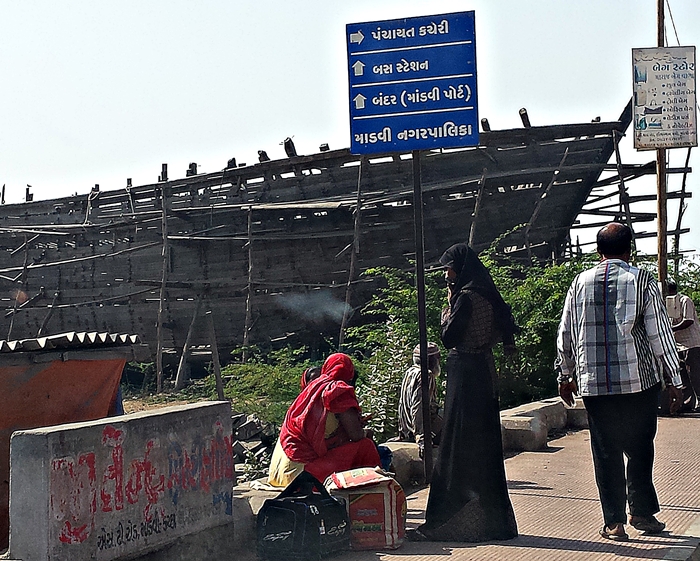
Get to know Gujarat better: boat-building in Kutch Mandvi
Gujarat has long been an important maritime interface between India and the rest of the world, especially Europe, Africa, and the Middle East. Many of its folk have been, and continue to be, involved in mercantile activities, sailing, and boat-building.
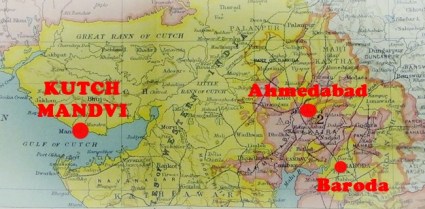
Mandvi in Kutch, which until 1947 was an independent princely state and is now part of Gujarat, used to be an important sea port. It is famed for its boat-building, which continues briskly even today. The wooden dhows constructed in Mandvi are now mostly built for customers in Dubai. They are built alongside the River Rukmavati that runs through Mandvi.
The timber used is ‘sal’ wood (Shorea robusta) that grows in Malaysia. This wood is both extremely durable and water-resistant.
With the exception of electrical saws, much of the construction employs age old techniques as can be seen in these pictures taken by Adam Yamey in early 2018.
Discover much more about Kutch and the rest of Gujarat in “Travels Through Gujarat, Daman, and Diu” by Adam Yamey, available in paperback by clicking HERE
The same book is available on Kindle by searching Amazon for “Travelling through Gujarat, Daman, and Diu“
While we were visiting the city of BARODA (Vadodara):
“…we visited the main railway station because it has a post office. Visiting the station is like visiting an art gallery. The façade and staircases of the large relatively modern station (1954) are decorated with colourful modern paintings and bas-reliefs, including a trompe l’oeil fresco depicting a steam engine with a large ‘cowcatcher’ emerging from a tunnel. There are also several interesting sculptures on the raised pavement in front of the station entrances. One of them, which I liked most, shows a model train on railway tracks. The tracks with the carriages on them have been bent into a spiral with the old-fashioned engine in the centre of the spiral.
We drank tea in a café located along one of the station’s long platforms. Platforms in many Indian stations are lengthy to accommodate the great number of carriages in long-distance express trains. Shorter local trains appear dwarfed by these platforms. We entered the post office through a door on the platform, which was partially blocked by bags of mail and parcels. This door was, we realised later, for the use of postal personnel. We found ourselves in a sorting office. Ladies dressed in colourful salwar kameez with dupattas draped over their shoulders were manually sorting mail, placing it into small square wooden pigeon-holes labelled with the names of towns all over India.
We were directed to the customers’ desk. We wanted to send a birthday card to our daughter in London and were concerned that it would arrive in time. When we asked the assistant serving us how long the card would take to reach London, she said it would be a week or two, and then added ominously: “…if it reaches at all.”
When we asked her whether I could take a picture of the postal sorters working, she referred us to her supervisor, who said: “Go ahead and take the picture, but make sure that it does not go viral”
IF YOU ENJOYED THIS AND/OR WANT TO KNOW MORE ABOUT GUJARAT,
I INVITE YOU TO READ MY NEW BOOK:
CLICK HERE FOR A PAPERBACK (also available from Amazon: here)
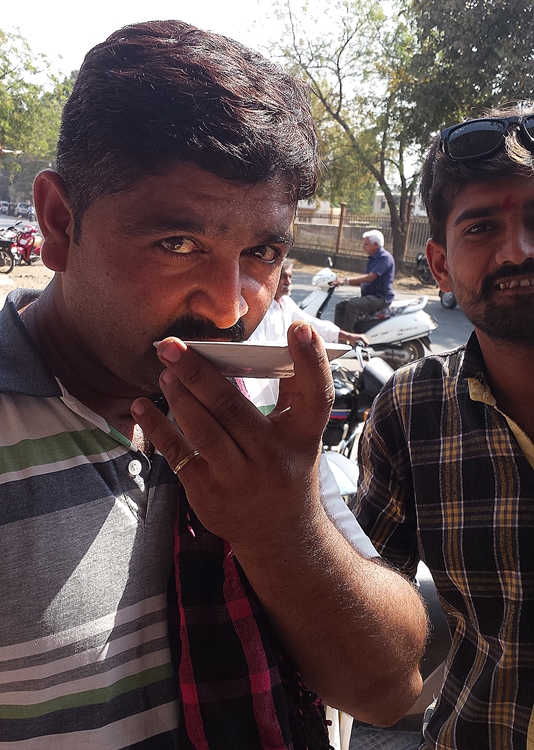
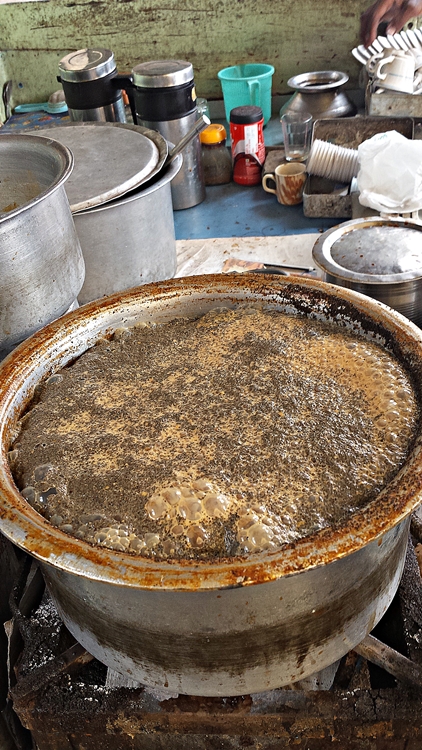
… all over Gujarat, tea is served in tiny cups, that can be finished in two or three swallows. It is invariably sweet. Our daughter describes these minute drinks as ‘sugar bombs’. They provide energy, rather than quenching thirst. Often, two men will share a tiny cup of tea. Half of the tea is poured into a tiny saucer, and one of the men slurps from it noisily. The other man drinks the rest from the cup. Tea shared this way is known as ‘cutting chai’. A reason for this practice is, apparently, to reduce sugar intake.
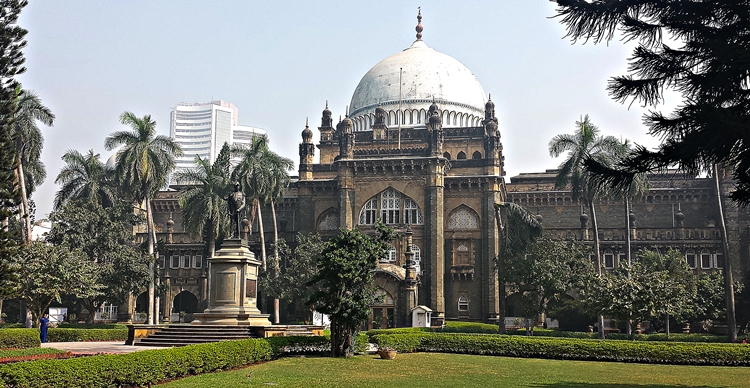
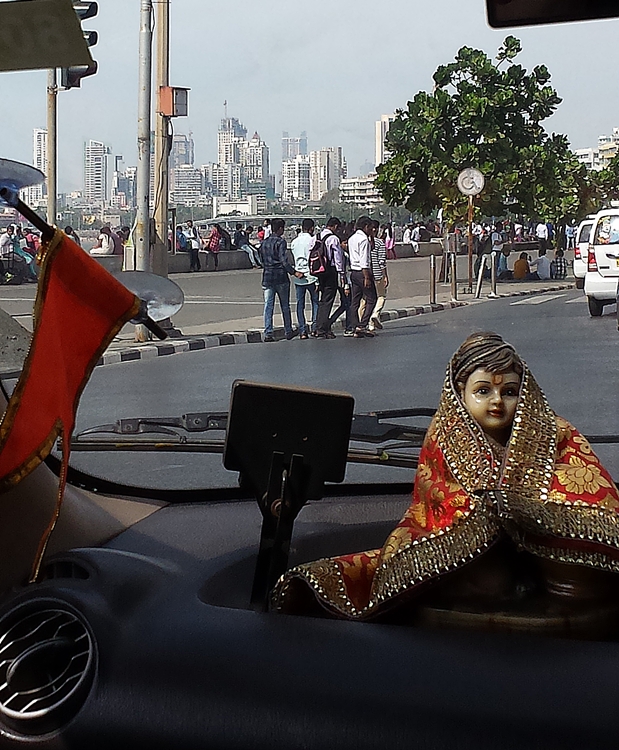
Before setting out on our two months of travelling through Gujarat, Daman, and Diu, we spent a fortnight in busy Bombay. Here are a few of the many photographs that I took in this bustling, vibrant city – the ‘Manhattan’ of India. How many of these places can you identify?
We left Bombay for Gujarat by train, embarking at Mumbai Central Station:
ENJOY ADAM YAMEY’s TRAVELS THROUGH GUJARAT, DAMAN, & DIU
Cyrus the Great, King of Persia and a Zoroastrian, ended the Jews’ long captivity in Babylon, and commanded them to rebuild the temple in Jerusalem
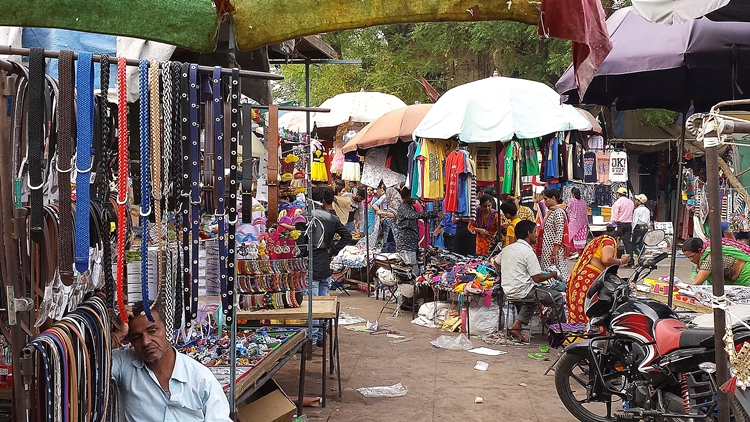
Market near Bhadra Fortress, Ahmedabad
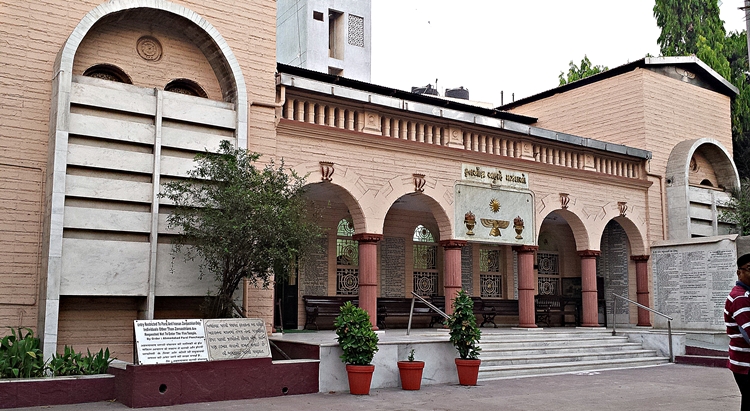
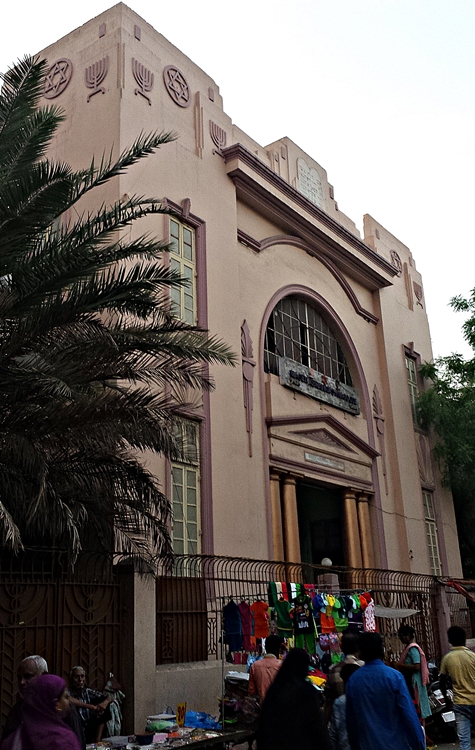
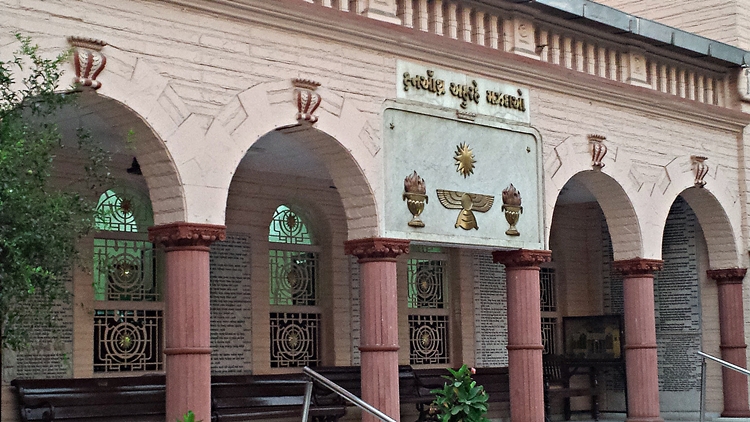
The places of worship of two of India’s minority religions face each other at one end of a small street in central Ahmedabad, not far from the busy market-place by the Bhadra Fortress. One building is the Magen Abraham Synagogue. Opposite, is a Parsi Fire Temple (‘agiari’). Both the Parsis and the Jewish people settled in India long ago and have lived there peacefully ever since. In proportion to their small numbers compared with the rest of India’s huge population, both communities, especially the Parsis, have made a disproportionately large positive contribution to the success of the country. In view of the great benefits they have provided to the country, some say that the Parsis are the ‘Jews of India’. Is this a fair description?
The Portuguese Jesuit priest Father Anthony Monserrate visited India in the early 1580s. After meeting Parsis in Navsari, he commented that they were: “…in colour they are white but are extremely similar to the Jews in the rest of their physical and mental characteristics, in their dress and in their religion.” This illustrates the priest’s poor understanding of the Parsis’ religion but does hint at his feeling that they had some similarities to Jewish people. Other travellers since the 16th century have remarked on similarities in the ways of life and public spiritedness of Jews and Parsis.
Parsi community office, Ahmedabad
The Parsis, followers of the Zoroastrian religion, fled to India from Persia during the 7th century AD to escape the Arab invaders, who wished to impose Islam on their home land. They began settling in Gujarat, where they have thrived for many years without suffering any more oppression than their Hindu neighbours. During various episodes of Islamic rule in India, both the Parsis and the Hindus suffered at the hands of their rulers.
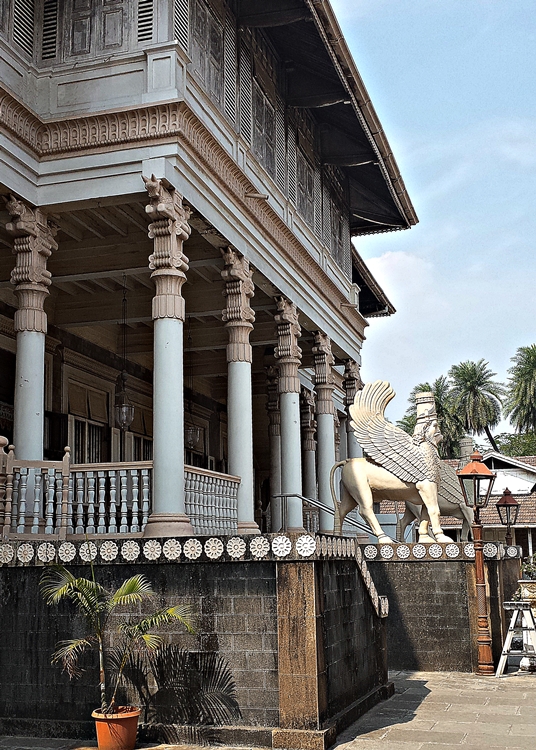
Parsi Fire Temple, Ahmedabad
Nobody is sure when Jewish people first settled in India. Likewise, no one is certain why they did. It might have been, like the Parsis, to escape oppression or, maybe, for commercial reasons. There were Jewish people in Kerala when St Thomas first landed there soon after the death of Jesus Christ. Other Jews arrived on the Malabar and Coromandel coasts later. They were refugees from the persecution of Jews on the Iberian Peninsula following the expulsion of the Moors. Later, others arrived from Iraq. The Jews of Kerala, who have had a largely successful history, and have now mostly emigrated, are different from the Jews, the more indigenous Bene Israel, who settled the states of Maharashtra and Gujarat.
Magen Abraham Synagogue, Ahmedabad
The small congregation of the Magen Abraham Synagogue in Ahmedabad is Bene Israeli. Their origins are quite unknown. In my new book about Gujarat, I wrote: “Ahmedabad’s small Jewish congregation are Bene Israel Jews, whose origin is totally obscure, but the subject of much speculation. One of these is that the ancestors of Bene Israel Jews were originally sailors in King Solomon’s fleet, who got wrecked at Navgaon near Alibag. However, Benjamin Israel, author of ‘The Bene Israel of India’, wrote that there is no evidence for this. Nor is there any good evidence about when the Bene Israel began living in India.”
Magen Abraham Synagogue, Ahmedabad
The numbers of both Parsis and Jews in India are declining. Like many other Indians with economic and other ambitions, both Parsis and Jews have emigrated to ‘improve’ their lives. Parsi numbers in India and beyond its borders are decreasing because of lowered birth-rate. Sayeed Unisa, RB Bhagat, and TK Roy wrote in their paper “Demographic Predicament of Parsis in India” (see: http://iussp2009.princeton.edu/papers/91429) : “Parsis are a small but prosperous religious community of India, which reached a peak of population of about 114 thousand in 1941. The recent census enumerated Parsi population about 69 thousand in 2001.” They concluded that based on available statistics, the population will continue to decline by between 0.6% and 1% per year.
In contrast, the decline in India’s Jewish population is far less to do with birth rates than with emigration. Jewish people have not left India because of persecution. It is safe to say that Jews in India have never been persecuted by Indians or their Islamic invaders. The Portuguese, who began occupying seaports on the coast of India in the 15th century, were almost the only people to persecute the Jews they encountered. Many of them were victims of the Inquisition in Goa. The main reasons for Jewish migration from India are to do with the establishment of the State of Israel and seeking economic betterment.
Many centuries have passed since both the Parsis and the various Jewish communities first settled in India. None of them have encountered as much persecution as the Parsis in 7th century Persia and the Jews in most of Europe. India provided these minorities with a safe haven. In return, both Jews and Parsis have given much to India.
Magen Abraham Synagogue, Ahmedabad
Is it reasonable to consider the Parsis as the ‘Jews of India’?
In terms of religious beliefs and customs, apart from monotheism, there are many differences. Like many of the Jews, the Parsis arrived in India as refugees, fleeing from persecution. Considered from the vantage point of what they have done for the greater good of India, the charitable Parsi communities have contributed to the well-being of India in a magnitude that is infinitely greater than their tiny population is in comparison with that of the country. In this respect, the Parsis resemble the successful Jewish communities of, say, Germany (formerly!), Great Britain, and the USA.
Adam Yamey’s new book about Gujarat, Daman, and Diu
I am not sure that we would have discovered the collection of cars assembled by the maharajahs of Gondal had we not had a detailed guidebook to Gujarat. Maybe we might have learned about it by chance but being in possession of a guidebook made certain that we were aware of it.
Detailed guidebooks of Gujarat, written in English, are few and far between. During the planning and our actual trip, we made use of two books.
Philip Ward’s “Gujarat Daman Diu – A Travel Guide” was published in 1994. Like his excellent guidebook to Albania, Ward presents Gujarat and its associated former Portuguese colonies in the form of a detailed, informative travelogue. It is a book that is both designed to be read in an armchair and to be used ‘on the road’. However, it was written before the earthquake of 2001 and its practical information is out of date. Nevertheless, it is a useful book for those who are planning to explore Gujarat.
The “India Guide Gujarat” by Anjali Desai was published in 2007. This colourful production includes many maps, which help with orientation but lack detail and were occasionally inaccurate. It is a thorough guidebook with entries on most of the places that are worth visiting in Gujarat. We made much use of the Kindle version of this publication during most of our trip until we reached Baroda, where we managed to obtain a paperback version, which is far easier to use than the electronic edition. Even though it is a few years out of date, anyone planning to visit Gujarat should carry a copy of it.
During our two month odyssey through Gujarat, Daman, and Diu, we saw many of the things recommended by Desai, but also attractions that she does not mention either because they have been built since her book was published or because of our exploratory instincts. One place, which gets a two line mention in Ward and three lines in Desai, is the collection of vintage cars at Gondal.
The collection is in the grounds of one of the palaces built by a Maharajah of Gondal to house his guests but is now used as a hotel. In my recently published book about Gujarat, I wrote:
“The grounds of this palace contain a collection of vintage cars, which I was permitted to see after paying an immodest fee (by Indian standards). More than thirty cars are stored in a series of garages surrounding a courtyard. They range in age from a pre-1910 model to some built in 1997. They include vehicles ranging from racing cars to small vans. Many of them were made in the USA, but others were British, German, and French. All of them are in immaculate condition, and, I was informed, each one is still in perfect working order. In Bombay, we saw some of these cars taking part in a vintage car rally held in February 2018. All the cars are owned by the family of the Maharajahs of Gondal. Photographs on the walls of the garages record the former royal family’s involvement with motor racing.”
We visited Gondal because of reading about it in Desai’s book. She mentions the palaces as being worthy of a visit, but our curiosity led us to discover more, which is not included in her book. One of these places, which I describe in detail in my publication is a large Victorian Gothic school, which was founded by a forward-thinking maharajah. We were fortunate to meet its headmaster, who provided us with fascinating insights into the school system of Gujarat. If it were not for Desai’s book, we would not have stopped in Gondal. If we had been less adventurous, we would not have visited the venerable school.
I regard the listings in guidebooks as nuclei around which the fruits of our curiosity can crystallise. My travelogue about Gujarat, Daman, and Diu describes a journey initially based on recommendations from guidebooks. It shares with the reader the myriad of experiences and discoveries, many of which have not yet been described in guidebooks, that we enjoyed in a part of India less-visited by foreigners and Indians alike.
A Parsi dharamshala (guest-house for pilgrims) near Udvada Station
The Parsis, followers of the ancient Zoroastrian religion, are few in number, making up a minute fraction of India’s population.
Fire Temple in Ahmedabad
In 2014, there were less than 70,000 Parsis in India, and this number is decreasing rapidly. Though insignificant in numerical strength, the Parsis have made a disproportionately enormous positive impact in many fields of activity in India and the rest of the world. To appreciate their achievements, one need only consider that the following well-known personalities are all of Parsi origin: the politicians Dadabhai Naoroji, Bhikaiji Cama, and Pherozeshah Mehta; the industrialist families Wadia, Petit, Tata, and Godrej; scientists Homi J Bhabha and Homi Sethna; musicians Kaikhosru Shapurji Sorabji, Zubin Mehta, and Freddy Mercury; military men including Sam Manekshaw; authors Rohinton Mistry, Firdaus Kanga, and Bapsi Sidhwa; actors John Farhan Abraham and Boman Irani; and a host of other famous people.
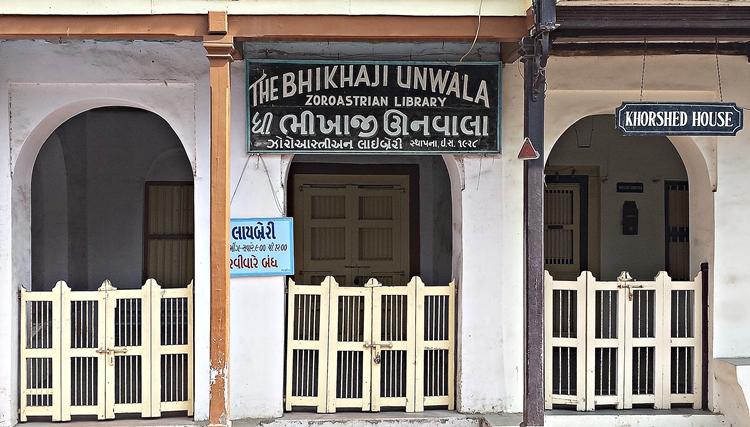
A Parsi library in Udvada
The Parsis originated in Iran (Persia). Following the invasion of Persia by Islamic forces, the Zoroastrians were persecuted by the invaders. Some of them chose to flee to India from Iran. It is not known exactly when this exodus began, but it is likely to have been sometime during the 8th century AD. In India, the Zoroastrians were free to observe their religious practices and were known as ‘Parsis’.
Entrance to a former Parsi Fire Temple compound in Diu
Although details are subject to discussion, it is widely thought that the Parsis first settled in Diu on the Saurashtrian coast of Gujarat for 19 years. They left this place when an astrologer-priest announced: “’Our destiny lies elsewhere, we must leave Diu and seek another place of refuge” (see: http://www.iranicaonline.org/articles/parsi-communities-i-early-history). They sailed across the waters from Diu to the coast of southern Gujarat, where it is believed they landed at Sanjan. They settled in Sanjan and places nearby including Udvada, Bharuch, Navsari, and Ankleshwar. Cutting a long story short, Parsi communities developed all over Gujarat and Maharashtra (notably in Bombay and Pune).
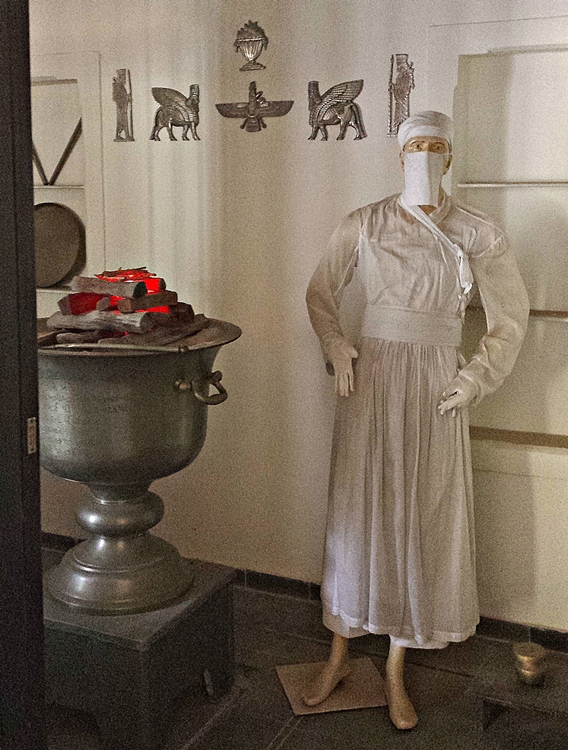
Model of a Fire Temple priest in athe museum at Udvada
As with other religions, Zoroastrianism has several unalterable core features. One of these is worship at Fire Temples. The Fire Temple, to which access is denied to all but Zoroastrians, contains a fire that must be kept alight by the priests. An English traveller John Jourdain (ca. 1572-1619) wrote of the Parsis in Navsari: “Their religion is farre different from the Moores or Banians for they do adore the fire, and doe contynuallie keepe their fire burninge for devotion thinkinge that if the fire should goe out, that the world weare at an end.”
Atash Behram in Udvada
During my recent trip to Gujarat, I visited Udvada, which is home to an extremely important Fire Temple. In my new book (see below), I wrote: “Udvada is home to a historically important, highest-level Parsi temple known as an Atash Behram (i.e. ‘Fire of Victory’). Established in 1742, this is the oldest of the eight Atash Behrams in the India. The sacred flame that it houses has been burning continuously for longer than any other Parsi sacred flames in India. Its sacred flame was lit on a bed of sacred ashes brought to India by the first Parsis to arrive there.” Being a functioning fire temple, my wife and I who are not Parsis, were unable to enter this esteemed place of worship.
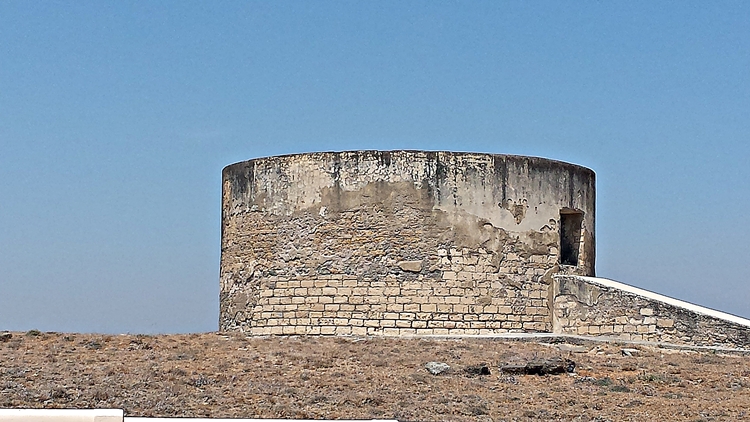
Disused Tower of Silence, Diu
Another characteristic of Parsi religious observances is the mode of disposing of the deceased. Although some Parsis are buried – I have visited a Parsi cemetery in Bangalore, the majority of Parsi corpses are dealt with quite differently. They are placed in the so-called Towers of Silence.
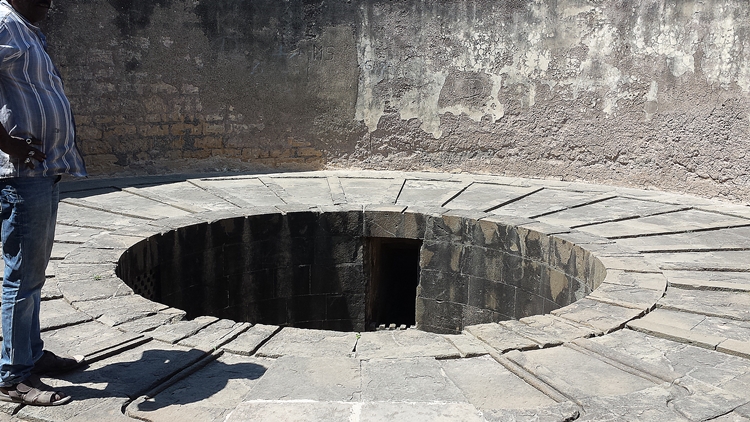
Interior of a Tower of Silence, Diu
I wrote that the Towers of Silence are: “… where the corpses of Parsis were traditionally left exposed to the sky so that their flesh could be consumed by vultures (a practice that may have begun in Persia by 900 AD).” In Bombay, there is now a problem: no vultures. I wrote: “The depletion of the vulture population has been attributed to the toxic medications, such as the painkiller diclophenac, that become concentrated in the corpses’ during life, and remain there after death.”
A disused Parsi building near a Tower of Silence, Diu
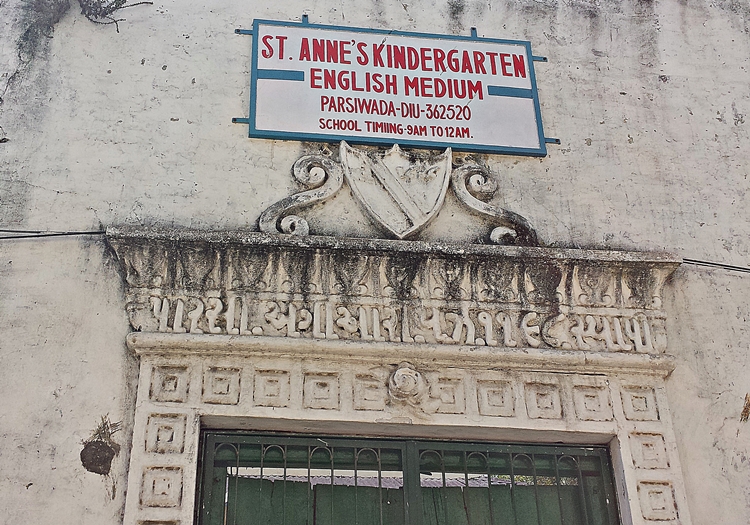
Like the Fire Temples, functioning Towers of Silence are out of bounds except for Parsis, alive or dead. There was a thriving Parsi community on the island of Diu, a Portuguese colony until 1961. Several decades ago, the last of the Parsis living in Diu left the island to settle elsewhere. The community that had lived there for many centuries had its own Fire Temples and Towers of Silence. These have long since become abandoned or re-used for other purposes. However, they retain enough of their original features to show visitors, who, like my wife and I, are not Parsis, what cannot be seen in functioning Fire Temples and Towers of Silence. What we found and much more is described in detail in my new publication.
READ AND DISCOVER MUCH MORE ABOUT VISITING FASCINATING PLACES
A short excerpt from Adam Yamey’s new book about Gujarat
In the Baroda Museum:
Baroda Museum
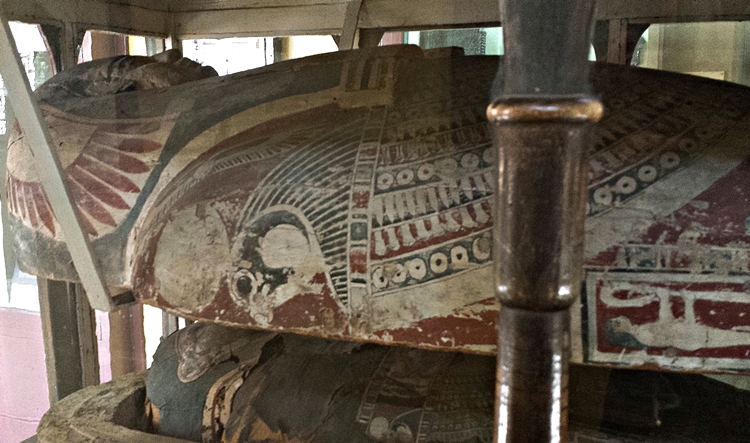
“There are two ‘memento mori’ on display. One is an Egyptian mummified corpse with exposed blackened feet, and the other is of more recent origin.
Unlike the painted container containing the age-old ‘mummy’, the other item concerned with the end of life is empty. It is a copper urn used to carry the ashes of Mahatma Gandhi to the Morli sangam at Chandod. Other urns, which contained some of the great man’s ashes, exist elsewhere. An article in the Guardian’s on-line newspaper, dated 31st of January 2008, says of another urn containing Gandhi’s ashes:
‘The vessel was one of dozens containing Gandhi’s cremated remains that were distributed around India in 1948.’
Close to the urn in Baroda, there is a letter of condolence written by Gandhi to a friend, who had just lost a daughter.
The letter, which was written on 19th of January 1948, includes the words:
‘Death is a true friend. It is only our ignorance that causes us grief. Sulochana’s spirit was yesterday, is today, will remain tomorrow”. Gandhi was assassinated eleven days after writing this. His spirit lives on.“





















 GUJARAT, DAMAN, and DIU