The author and his book…

ADAM GUJU BOOK

“Travels through Gujarat, Daman, and Diu” by Adam Yamey is a personal introduction to a part of western India far less well-known than its neighbour Rajasthan.

First, a bit about the author:

Adam Yamey is the author of several books, including: Albania on my Mind, From Albania to Sicily, Exodus to Africa, Rediscovering Albania, Aliwal, City on the Hooghly, Buried in Bangalore, Bangalore Revealed, and A Boer in Bangalore.

Born in 1952 in London, son of South African parents, he attended Highgate School, and then University College London. After a doctorate in mammalian physiology, he became an undergraduate once more and qualified as a dental surgeon. After 35 years in general dental practice in Kent and London, he retired in September 2017.

Amongst his many achievements, he has been Chairman of both the Maidstone Recorded Music Club and the Medway Association of Dentists. In August 2008, he gave an Independence Day speech to pupils of a school in northern Kerala. Some years later, he gave a presentation at the National Institute of Advanced Studies in Bangalore. More recently, he has been editing the newsletter of the Anglo-Albanian Association.

Adam married Lopa, from India, in 1994, and, since then, has been visiting her native land very frequently. India has become his second home. He is a keen traveller. The periods between his journeys are usefully and enjoyably employed with: family, cooking, writing, editing a newsletter, theatre, and exploring the many delights that London has to offer.


Here is the list of the contents of this profusely illustrated travel book:

The Firozpur Janta Express (‘p.’ = page. 7)

DAMAN: (p. 11) A Portuguese fort; Cutting chai; In jail

BOMBAY: (p. 28) A shortage of vultures

KUTCH MANDVI: (p. 31) Kutchi beer; Highgate in the heat; Marriage in Mandvi; Dhows

BHUJ: (p. 51) Palace of mirrors; The dairyman; Leaving Kutch

RAJKOT: (p. 65) Gandhi lived here; A famous pupil; Reserved for ladies

GONDAL and VIRPUR: (p. 80) The Buddhist caves

JUNAGADH: (p. 88) A lively bazaar; Fantastic tombs; The citadel; The Nawab’s dogs

PORBANDAR: (p. 108) City by the sea; Gandhi’s birthplace; Something fishy; A floating stone; Another bus

SOMNATH: (p. 136) The Queen’s temple; Krishna stood here

DIU: (p. 150) A border crossing; Portuguese traces; The Governor’s grandson; Towers of silence; Four bangles; A Governor’s insanity; Laxmi Park; The fire temple

BHAVNAGAR: (p. 193) A silver bracelet; A royal encounter; Constructing a cobra; Graveyard for ships

Leaving Saurashtra (p. 219)

BARODA: (p. 222) A market; Floors of glass; A deserted city; A voice from the depths; A military base

AHMEDABAD: (p. 257) Tree of Life; Lunch in a graveyard; Before the Taj Mahal; Books under a bridge; Gandhi and Le Corbusier; The heat of the day; Music at sunset

Epilogue (p. 297)

Glossary  (p. 299)

Potted history of Gujarat (p. 304)

Books consulted (p. 306)

Acknowledgements (p. 308)

Index (p. 310)

The book is available from on-line stores such as:

Amazon, bookdepository.com, & lulu.com

There is also a Kindle version called:

“Travelling through Gujarat, Daman, and Diu”

A royal palace by the sea

A POR 1

Sand drifts relentlessly up from the seaside towards the gracefully decaying, rambling Huzoor Palace in Porbandar (Gujarat), the birthplace of Mahatma Gandhi.

Prior to 1947, what is now the State of Gujarat was divided up into more than 200 ‘independent’ Princely States. Many of the rulers of these states were wealthy. Most of them built elaborate palaces like this one built in the early 20th century by Nawarsinhji Bhavsinhji Sahib Bahadur, who ruled from 1908-48 and was a first-class cricketer, who played for India in a Test Match in England in 1932.


A POR 2

Discover more about Gujarat in

TRAVELS THROUGH GUJARAT, DAMAN, AND DIU

by Adam Yamey

Available by clicking HERE

Also, from Amazon and on Kindle


An underground well

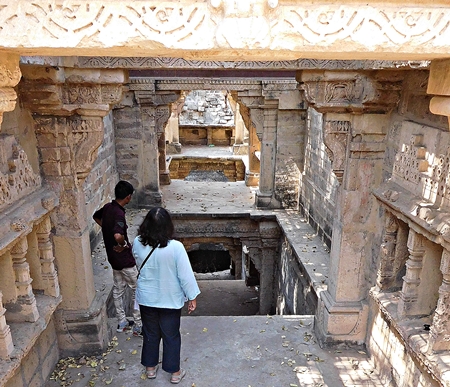
VIRPUR STEP

The step well at VIRPUR in Saurashtra is typical of the subterranean wells found all over the State of Gujarat. A series of staircases lead underground to a deeeply located well head. The staircases are connected with galleries through which light filters down to the depths. These wells often doubled up as meeting places for women and underground Hindu shrines. This well at Virpur is prized by women seeking enhanced fertility.

Learn much more about step wells in Adam Yamey’s book:

TRAVELS THROUGH GUJARAT, DAMAN, AND DIU

Available: https://www.bookdepository.com/Travels-Through-Gujarat-Daman-Diu-Adam-YAMEY/9780244407988

And on Amazon as well as Kindle

Gujarat and Sicily

Invaders adopting the architecture of the invaded

I have just returned from a trip to Palermo, the capital of the iskland of Sicily. This island has been invaded by different peoples numerous times. Visiting it made me reflect on aspects of my recent visit to Gujarat

FUS 1
The Zisa Palace built by the Normans near Palermo (Sicily)

In the 9th and 10th centuries (AD), Sicily was ruled by Muslim Arabs. They were displaced by Christian Norman invaders in the 11th century. Little remains of buildings erected during the Arab occupation, but people of Arabic origin remained behind in Sicily when the Normans arrived.

The Normans built castles, churches, and cathedrals in Sicily. Many of these may be viewed today. What interested me about them is that these structures contain many architectural features typical of Arabic architecture. I suspect that the Normans must have employed Arabic craftsmen during the construction of their buildings.

FUS 2
The Norman church of St Cataldo in Palermo

Moving eastwards to India, let us consider the architecture in Gujarat. Gujarat began to be invaded by Muslim forces (Turks, Mughals, etc) in the 14th century. Some Muslim rulers respected the Hindu religion they found when they arrived there; others did not. Hindu temples, like that at Somnath, were vandalised and destroyed. 

FUS 4
Recovered remains of an 11th century Hindu temple at Somnath (Gujarat)

Despite a prevailing prejudice against Hinduism, the Muslim invaders were content to borrow the architectural features of Hindu temples when they constructed their new (15th century, mainly) mosques. I have written more about this in an earlier blog article (see: https://gujarat-travels.com/2018/08/04/style-fusion-in-gujarat/ ).

FUS 3
A 15th century mosque at Pavagadh (Gujarat)

The invaders of both Arabic Sicily and Hindu Gujarat made use of the local architectural features they found when they arrived as conquerors, but they also introduced new architectural styles that they brought with them. The Normans brought northern Gothic, and the Muslim invaders of Gujarat imported Persian architectural ideas. Later, the British, having invaded India, managed to fuse features of gothic, Persian, Mughal, and Hindu architecture to create what is sometimes called “Indo-Saracenic”architecture. Many public buildings in Gujarat are fine examples of this Victorian era fusion.

FUS 5
Inside a 15th century Muslim mausoleum at Sarkej Rauza (Ahmedabad, Gujarat)

Discover more about Gujarat in the new book by ADAM YAMEY:

Travels through Gujarat, Daman, and Diu

It is available on lulu.com, Amazon, bookdepository.com, and Kindle