Large snakes

The Laxmi Vilas Palace in Vadodara was built for the Gaekwad (Maharajah) of Vadodara in 1890 to the designs of the British architects Charles Mant and Robert Chisholm. It covers an area four times as large as London’s Buckingham Palace. This Victorian era Indo-Saracenic pile is now one of the main tourist attractions of Vadodara. What little of it that visitors are permitted to explore of this pastiche of various Asian and European architectural styles is overbearingly impressive but not of great aesthetic value.

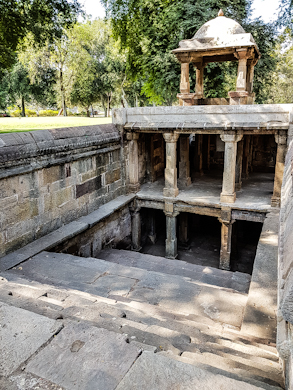
My main reason for visiting the palace was to see the Navlakhi Vav, a subterranean stepwell built in the 15th century. The stepwell has five levels of stonework galleries, all underground and one above the next. I was looking forward to exploring this, rather than the relatively uninteresting palace.

The official at the ticket booth for the palace compound told us that the ticket included access to the vav. He omitted to tell us that approaching this stepwell is now forbidden.

A security guard stands about 50 metres from the domes built above the vav. He told us that he would lose his job if he allowed us to go closer to the stepwells. Although his job was poorly paid, so he told us, it would be difficult for him to find another. He suggested that we returned to an office in the palace and spoke to a young lady whom we would find there.

When we explained my interest in stepwells to her, she accompanied us back to the guard, telling us that we could approach the outer walls of the stepwell but should not enter it. At present, she explained, the vav was not in good condition because stones kept falling from its structure. Additionally, the stepwell is currently infested by large snakes. She told the guard to take us to the structure. Although we could not enter the complex structure of the vav, we were able to see something of it over the low walls enclosing it at ground level. We could hear water splashing deep below us in the well in the deepest part of the stepwell.

The serpent infested vav is separated from where the guard stands by the tee of one of the 18 holes of the Laxmi Vilas golf course. We asked the guard whether the golfers, who had to stand close to the vav, were in any danger from the large snakes.

“No,” he replied in Gujarati, “they are not.”

“Why not?” we asked.

“Because they are members of the golf club,” the guard informed us.
Kites and cyclists

MAKARA SAKRANTI or UTTARAYAN, as it is known in Gujarat, is a Hindu festival held in mid January. It marks the beginning of the lengthening of day length, a month after the winter solstice.

Kite flying is a popular way to celebrate the festival. The kites are either attached to fine nylon strings or other threads sometimes covered with tiny fragments of crushed glass. Some kite flyers like to try to use their glass covered kite threads to sever the threads of other airborne kites.

The trees and ground are littered with paper kites that have escaped their owners. We have seen many of these in Vadodara.

Frequently, kites on long threads descend groundwards. The threads may cross busy roads. They offer danger to speeding motorcyclists. There is a real risk of drivers having their throats and faces severely injured by the almost invisible kite threads stretched across the road.

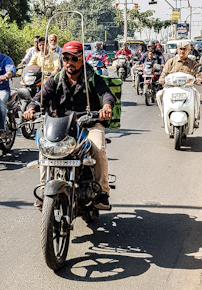
Prudent motorcyclists attach tall metal hoops from one handle bar to the other. These hoops will sever the hazardous kite threads before they can injure the cyclists’ throats.

Tea makers and politicians

Street tea making stalls are found all over India. They are great places for quenching your thirst and avoiding low blood sugar situations.

I am writing this during a visit to the Gujarati city of Vadodara, where we spoke to two tea makers this morning. One of them was a charming lady, who told us that she manned her stall from 630 am until 730 pm daily. She heats her tea on a gas ring. The gas cylinder contains enough gas for 15 days.

India’s present Prime Minister, Narendra Modi, worked briefly as a tea maker (‘chai wallah’) during his childhood. There is a chai wallah in Bangalore, whose shop is in Johnson Market. Not only does he serve excellent tea, but also he works as a local politician. He has his own party, whose symbol is a pocket calculator. He stands as a candidate in elections, but has never yet won any of them. He told us that if one chai wallah could become Prime Minister, there is no reason why another could not do the same.

Gopal , who has a tea stall near the entrance to one of the former pols* of Varodara, works from 10 am to 6 pm. His stall was very busy when we visited it this morning. It faces a peepal tree with numerous Hindu offerings around the base of its trunk. One of the daily offerings to the gods is the first cup of tea that Gopal makes each morning.

Like most other chai wallahs we have visited in Gujarat, Gopal adds fresh herbs and spices to his tea. Today, he had large sprigs of mint leaves and bunches of lemon grass and ginger. He pounds the latter in a pestle and mortar. He told us that pounding the ginger releases more flavour than grating it, which is what many chai wallahs do.

I asked Gopal whether I could take photographs of him and his stall. He allowed me to do so. As we were leaving him, he told his customers proudly (in Gujarati):

“Our Prime Minister has to go to the UK and USA to have his picture taken. See, people from the UK have come all the way from London to Vadodara to photograph me.”

* A pol is an ancient form of gated community, built for protection, found in the historic centres of Varodara and (more prevalently) Ahmedabad.

Don’t let it go viral

Snap a photo

in the sorting office:

make sure it don’t go viral

Baroda 1

While we were visiting the city of BARODA (Vadodara):

“…we visited the main railway station because it has a post office. Visiting the station is like visiting an art gallery. The façade and staircases of the large relatively modern station (1954) are decorated with colourful modern paintings and bas-reliefs, including a trompe l’oeil fresco depicting a steam engine with a large ‘cowcatcher’ emerging from a tunnel. There are also several interesting sculptures on the raised pavement in front of the station entrances. One of them, which I liked most, shows a model train on railway tracks. The tracks with the carriages on them have been bent into a spiral with the old-fashioned engine in the centre of the spiral.

BARODA 2

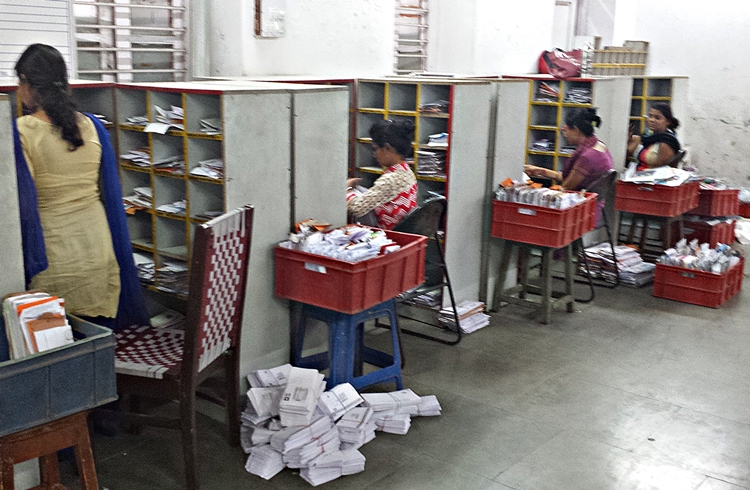
We drank tea in a café located along one of the station’s long platforms. Platforms in many Indian stations are lengthy to accommodate the great number of carriages in long-distance express trains. Shorter local trains appear dwarfed by these platforms. We entered the post office through a door on the platform, which was partially blocked by bags of mail and parcels. This door was, we realised later, for the use of postal personnel. We found ourselves in a sorting office. Ladies dressed in colourful salwar kameez with dupattas draped over their shoulders were manually sorting mail, placing it into small square wooden pigeon-holes labelled with the names of towns all over India.

Baroda 2a

We were directed to the customers’ desk. We wanted to send a birthday card to our daughter in London and were concerned that it would arrive in time. When we asked the assistant serving us how long the card would take to reach London, she said it would be a week or two, and then added ominously: “…if it reaches at all.”

Baroda 3

When we asked her whether I could take a picture of the postal sorters working, she referred us to her supervisor, who said: “Go ahead and take the picture, but make sure that it does not go viral


IF YOU ENJOYED THIS AND/OR WANT TO KNOW MORE ABOUT GUJARAT,

I INVITE YOU TO READ MY NEW BOOK:

CLICK HERE FOR A PAPERBACK (also available from Amazon: here)

CLICK HERE FOR A KINDLE

His spirit lives on…

A short excerpt from Adam Yamey’s new book about Gujarat

GUJ LULU PIC


In the Baroda Museum:

bar 2
Baroda Museum

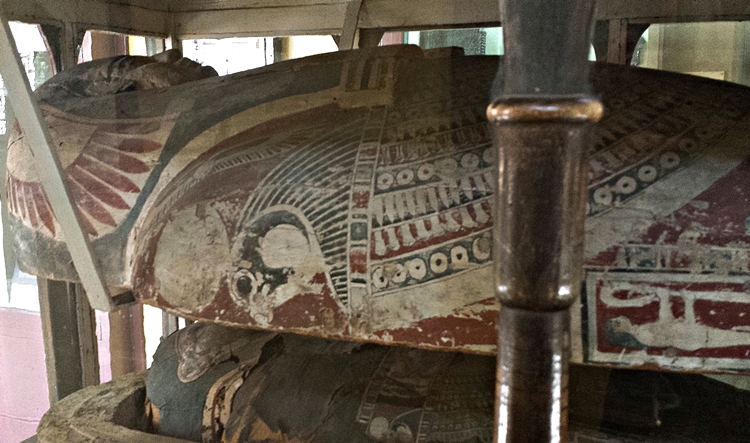
There are two ‘memento mori’ on display. One is an Egyptian mummified corpse with exposed blackened feet, and the other is of more recent origin.


bar 1

Unlike the painted container containing the age-old ‘mummy’, the other item concerned with the end of life is empty. It is a copper urn used to carry the ashes of Mahatma Gandhi to the Morli sangam at Chandod. Other urns, which contained some of the great man’s ashes, exist elsewhere. An article in the Guardian’s on-line newspaper, dated 31st of January 2008, says of another urn containing Gandhi’s ashes:

‘The vessel was one of dozens containing Gandhi’s cremated remains that were distributed around India in 1948.’


bar 3

Close to the urn in Baroda, there is a letter of condolence written by Gandhi to a friend, who had just lost a daughter.


bar 4

The letter, which was written on 19th of January 1948, includes the words:

‘Death is a true friend. It is only our ignorance that causes us grief. Sulochana’s spirit was yesterday, is today, will remain tomorrow”. Gandhi was assassinated eleven days after writing this. His spirit lives on.


ADAM’S BOOK IS AVAILABLE AS

A PAPERBACK BY CLICKING HERE

A DOWNLOADABLE KINDLE BY CLICKING  HERE